Have you heard an “elevator speech”? It’s a brief summary of who you are, what you do, and your career or project goals—with an emphasis on brief. Imagine running into the CEO of the dream company you’d like to work for, while waiting in line for coffee or taking an elevator: you will need a well-planned pitch that you can deliver concisely, clearly, and with confidence. Your elevator speech is an abbreviated version of your response to the common job interview question, “Tell me about yourself.” Having a well-prepared pitch to share at a moment’s notice is essential to grabbing your audience’s attention—and to leave them wanting to learn more about you. An elevator speech is also easy to tailor for different audiences, once you have your first draft.
Basic guidelines
Keep it short (30 seconds to 2 minutes).
Capture the person’s attention early and state your goals clearly.
Focus on the why. This will convey the big picture and the importance of your work.
Consider the audience: don’t use jargon or acronyms that your listener may not understand.
Tell your story with enthusiasm.
Make it personal: it is about you, your work or research, your strengths.
Leave some room for the imagination. People will definitely ask follow up questions, if they are interested in learning more about you.
Invited by the Office of Postdoc Affairs and Core Programs—Office of Graduate Student Affairs in The Graduate School, Dr. Mike Matrone, Associate Director for Office of Career & Professional Development at the University of California, San Francisco led a workshop on this topic in late August. To help you get started on drafting your elevator speech, below are example prompts from the workshop.
An easy way to start drafting your elevator speech
Example 1: You’re interviewing for your dream job, and are expected to answer, “Tell me about your research.”
Background
I am a ______/ I study_____
Supporting Details
My question is…
My approach is…
Findings & Conclusion
I discovered that _________________
This is important because _______________
In the future______________
Example 2: You’re a speaker at TEDx Seattle.
Bottom line
My name is _____________ and I am a ____________.
So what?
Did you know___? / Every year___
I found that___
This is significant because ___
Supporting details
I did this by___
Nuggets of what’s next
Last but not least, the elevator speech is not something you can make up on the spot. It’s important to think ahead, prepare a draft, and practice your delivery. Practice is always the key to success. Practice with peers or mentors. Check out the following resources below on crafting an elevator speech.
Have you heard of an “elevator speech”? It’s a brief summary of who you are, what you do, and your career or project goals—with an emphasis on brief. Imagine running into the CEO of the dream company you’d like to work for, while waiting in line for coffee or taking an elevator: you will need a well-planned pitch that you can deliver concisely, clearly, and with confidence. Your elevator speech is an abbreviated version of your response to the common job interview question, “Tell me about yourself.” Having a well-prepared pitch to share at a moment’s notice is essential to grabbing your audience’s attention—and to leave them wanting to learn more about you. An elevator speech is also easy to tailor for different audiences, once you have your first draft.
Basic guidelines:
Keep it short (30 seconds to 2 minutes).
Capture the person’s attention early and state your goals clearly.
Focus on the why. This will convey the big picture and the importance of your work.
Consider the audience: don’t use jargon or acronyms that your listener may not understand.
Tell your story with enthusiasm.
Make it personal: it is about you, your work or research, your strengths.
Leave some room for the imagination. People will definitely ask follow up questions, if they are interested in learning more about you.
An easy way to start drafting your elevator speech:
Example 1: You’re interviewing for your dream job and are expected to answer, “Tell me about research.”
Background
I am a ______ / I study ______
Supporting Details
My question is…
My approach is…
Findings & Conclusion
I discovered that ______
This is important because ______
In the future ______
Example 2: You’re a speaker at TEDx Seattle.
Bottom line
My name is ______ and I am a ______
So what?
Did you know ______? / Every year ______
I found that ______
This is significant because ______
Supporting details
I did this by ______
Nuggets of what’s next
Last but not least, the elevator speech is not something you can make up on the spot. It’s important to think ahead, prepare a draft, and practice your delivery. Practice is always the key to success. Practice with peers or mentors.
Best,
Core Programs—Office of Graduate Student Affairs UW Graduate School
Welcome all new and returning graduate students across the University of Washington tri-campus! You bring rich and unique experiences to the university, whether you have recently moved to Washington state from another part of the U.S. or the world, have just completed an internship, fieldwork, a fellowship, or are further along in your capstone or research project. And your lives are not just about your studies or putting in lab or teaching hours—many of you also have families and strong connections with your communities, work off and on campus, and enjoy varied hobbies and interests. You are all a vital part of the university ecosystem. As you enter the new quarter, consider the following strategies to help you get started on the right foot.
What you’re feeling is normal. Graduate school can bring up feelings of excitement, anxiety, fear, or homesickness. You are definitely not alone in this, as many of your peers have experienced similar feelings. Academia can also make you feel like you are not smart enough or capable enough (aka imposter syndrome). This is simply not true. Whenever you’re in doubt, remember that you do belong at the University of Washington. You are in graduate school to enhance or change your career, provide for your family, or make important contributions to your discipline or industry.
Find your people. Graduate school can open up positive opportunities for your intellectual, professional, and interpersonal growth, yet it can also be challenging, stressful and isolating at times. With this in mind, we encourage you to seek out ways to connect with peers in a variety of settings. Network with peers at departmental and campus events. Join or start a local meetup group based on shared interests and connect with peers on the UW Graduate Students facebook page. Consider co-organizing a potluck with members of your cohort—you end up saving money and food always brings people together.
Take it one step at a time. For the past few weeks, you have participated in orientations, received lots of information about student resources and program requirements—and if you’re new to the Puget Sound region—navigated finding a place to live, while managing any number of daily living errands. When you find yourself feeling overwhelmed, pause for a moment to take a few deep breaths. Get in the habit of reminding yourself that it’s neither sustainable nor realistic to do it all right now. To organize your days and weeks, use a time management tool such as a paper planner, app, or online calendar. Break down big projects into smaller, more manageable tasks. And remember to reward yourself when you finish a task.
We hope you find these tips useful, and let us know what has worked for you!
*This story is part of a series celebrating the 50th anniversary of GSEE.
Welcome to the start of the GSEE story! We are so proud of our history, our struggles, our achievements, and, especially, our alumni.
As part of our 50th anniversary celebration, we produced a timeline that incorporates profiles of our alumni from the past five decades. We hope these profiles give you a sense of the evolution and impact of GSEE more than just the dates and facts would.
Our story officially begins in 1970, when the Office of the Recruitment for Minority Graduate and Professional Students was established.
But of course, there was so much that led to that office. In 1968, the Black Student Union was created and immediately established itself as a student organization to be taken seriously, issuing a list of demands to President Odegaard, and then staging a sit-in to have those demands met. This prompted a cascade of changes at the University of Washington, including the formation of what is now known as the Office of Minority Affairs & Diversity (OMA&D).
Initially a part of the Office of Minority Affairs, the Office of the Recruitment for Minority Graduate and Professional Students’ main activities were recruitment, counseling and providing financial support to students of color.
Later that year, President Charles E. Odegaard approved the joint administrative title of Assistant Dean of the Graduate School and Special Assistant to the Vice President for Minority Affairs, starting a formal relationship between the two units.
Establishing this relationship meant that specific attention was now being given to the unique challenges and needs of graduate students of color. You’ll hear alumni’s experiences through the years, how their graduate education experience at UW was, and all the myriad ways that GSEE supported them, and where they are in life now.
This timeline is based on OMA&D’s 50th anniversary timeline. Special thanks to OMA&D and UWAA for their partnerships and support; Jessica Salvador, whose student paper on GSEE’s history was invaluable; Linda Dodson of UW Archives, and to all the alum who generously shared their stories.
Every year in the Department of Psychology, there was one graduate student of color who was charged with supporting students of color within the program. This official departmental position was funded by a fellowship from GO-MAP*. I was one of the graduate students who held this position in the 1980’s.
The support position and resulting community were extremely effective. Students of color in our department never felt like that they were on their own. The tight community of students of color smoothed new ethnic students’ entry into graduate school and the field of psychology. There were always more advanced students ready to answer questions and provide direction and encouragement to incoming and intermediate-level students. The willingness of more advanced students to advise, inform and socialize with new and mid-level students was a stepping stone to success for so many of us. This position and organization stewarded a network of students of color who became role models for others in navigating academics and finishing our degrees. I am grateful for all the students of color who shared their strengths and encouraged us, teaching us to pass on this legacy of support.
Among its responsibilities, this network of students of color was also involved in the admissions process, reviewing files of prospective students of color. We provided input to faculty on the department admissions committee. The group of students of color active in the mid-80’s also played a small role in bringing Dr. Ana Mari Cauce (now UW president) to the Department of Psychology as faculty. We were lucky enough to meet and dine with Dr. Cauce when she came to the UW for her initial interviews. I remember my initial impression of Dr. Cause as highly intelligent and quick-witted, with an infectious laugh.
After I graduated, I served as faculty in the Department of Psychiatry and Behavioral Sciences, focused on child assessment in the clinic now known as the Center on Human Development and Disability. I also worked in private practice for a number of years, and taught briefly at Antioch University in the master of psychology program.
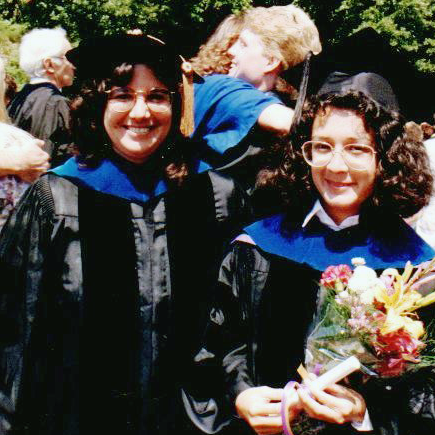
On a personal note, after joining the Department of Psychology, Dr. Cauce kindly stepped in to take over as my dissertation advisor when my original professor departed. At the end of my dissertation defense, I informed Ana that I would be skipping graduation and would just pick up my diploma from the Registrar. Ana looked at me, and said she understood why I would feel that way, but insisted skipping graduation was something I would regret later. She mentioned that she had not put on doctoral robes for her own graduation, and then made me an offer. Ana said that if I decided to go through graduation, she would also march in her doctoral robes with the faculty. This was something we could celebrate together. I still appreciate the kindness of her awareness and assistance.
*This story is part of a series celebrating the 50th anniversary of GO-MAP, now known as GSEE.
Wooden works in the Seattle area and is a full-time entrepreneur, with a number of projects in health and biomedical sciences. Wooden recalls how GO-MAP* functions helped him get out of the lab and make connections across disciplines.
Graduate school can be very arduous for people. It can be a long road, with a lot of ups and downs.
Cynthia and the others in the GO-MAP office were always there to support you if there was an issue you were dealing with. I remember when I received my funding both from the Ford Foundation or the UNCS Burke Science Initiative, GO-MAP did all this work behind the scenes to make things as seamless as possible. That way, I could focus on my research and not the paperwork.
GO-MAP had some really good functions where they would invite all of the minority graduate students. At that time, in my department I was the only person of color. So it was a great way to meet all of the other graduate students of color who you normally wouldn’t see because you were all scattered.
At these receptions we’d hang out, make friends, and have conversations if there were issues people were struggling with. There, students from very different disciplines were able to connect as we’re going through our graduate school experience and encourage each other through our everyday struggles.
Sometimes there would be very deep discussions about topics outside of school. I still remember this conversation I had with someone from Astronomy about their disciplines and practices in their discipline versus Genetics. That’s one conversation you remember forever.
We would exchange information and some of us would go out and do things after those events. People would reach out and say, hey I’m hosting a party, or we’re going out to this place, and you should come along. It was good to get you out of the books or your lab. To add some fun to the mix and help you stay grounded.
I would always look forward to those receptions – to seeing Cynthia Morales and other UW administrators. Some of those friendships I made at GO-MAP receptions, I still have to this day.
*This story is part of a series celebrating the 50th anniversary of GO-MAP, now known as GSEE.
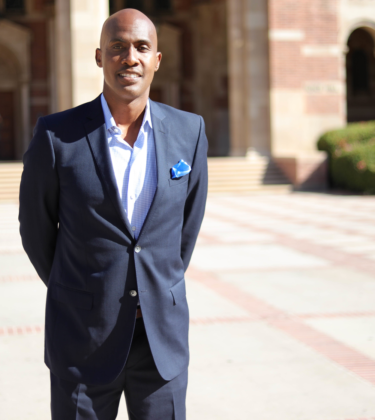
Dr. Howard came to the UW after teaching in elementary school classrooms in Compton, California. Advised by Professor James Banks (the “Father of Multicultural Education), Howard studied multicultural education, academic achievement among African Americans, and equity in the classroom. Howard has continued onto an impressive career as a professor of education at University of California – Los Angeles, where he continues to study race and equity in K-12 education. At UCLA, Howard is the former associate dean of the Graduate School of Education & Information Studies and the founder and executive director of the Black Male Institute. He is frequently asked to present his work across the country and globe. In 2019, Howard was honored with the College of Education’s 2019 Distinguished Graduate Award. We spoke with Howard about how GO-MAP* (then known as the Minority Education Division) enhanced his graduate school experience at the UW, and the program’s lasting influence on his career.
For me, the Minority Education Division was about family and about community as well as financial support. From a financial standpoint, I was what might be called now a non-traditional student. I had a wife and two kids when I started my graduate degree.
I had funding through the School of Education but it was not enough. I didn’t want to work three, four or five jobs outside of the UW to make ends meet. So I would go to Cynthia and talk to her about the financial challenges we were facing, and Cynthia would find something. MED was a huge financial support in ways I could not have envisioned when I started graduate school.
At one point I approached Cynthia because it was a real tight squeeze for my family and I to make ends meet. I was really hesitating to talk to her, because I didn’t know what she would say. Before I met with her, I put together five talking points on the subject. I planned points and counterpoints; I had all these things prepared to say if she said no.
I went in nervous to our meeting, prepared to hear no. As you probably know, Cynthia has such a calm demeanor. As soon as I brought up my first point, she said yes. She said, I’ll make it happen, and she made it seem like it was so easy.
That conversation was life changing. It was so important to know that she got it and she made it happen. All the talking points I had prepared, I didn’t have to go through because she was so responsive.
When I was looking at graduate programs and I visited the UW, there was a group of master’s students in the College of Education who were incredibly helpful. Patricia Halagao, Cynthia Denning Del Rosario, Jim Rodriguez, and Andre Branch. They said, there’s a space for people of color here at the UW. They told me it was a good place to consider because my work – on racial and ethnic diversity in the classroom – would be supported here. It meant a lot to hear current graduate students say that they felt supported on campus.
As a graduate student, you recognize that the school – for me, both the College of Education and the UW – were predominantly white. If you didn’t find a community of like-minded people, you could feel very isolated and very disconnected. As a person of color, you have to create your own community within the larger community by finding pockets of people who share the same experiences as you.
MED provided a space where I saw other students of color. With MED students, I didn’t feel like I was alone, and I had people who could relate to being the only or one of the few people of color in their programs.
What was helpful for me was to come into graduate school with a small group of people who were part of the Office of Minority Recruitment and Retention. That became my community. The folks I worked with in my department knew about the Minority Education Division, Mosaic and other organizations to plug into to find community, so they helped me seek out those opportunities.
It worked for me, but if you didn’t know how to find that community, you would be on the outside looking in. Now there are more intentional steps and approaches so incoming students of color can be introduced to these units and plugged into communities of color, if they desire to be.
My involvement with MED has been huge for my career. As a grad student, it was good to be in a place where people helped you to sharpen your ideas and pushed you – always with kindness – to sharpen your methods.
When you’re a graduate student, you’re insecure as a scholar. For me, having people who were part of the UW community who supported my ideas – conceptually and intellectually – allowed me to recognize the importance of my work. Professors such as Jim Banks, Gevena Gay, and Ed Taylor were invaluable and incredibly supportive.
A lot of the work I do now is still tied to equity and inclusion. I wouldn’t be doing this work if I hadn’t had the support I had at the UW. This support let me know that my work matters to the community. I’m forever indebted to the community because of that.
I hope the university does all it can do to support efforts like GO-MAP. Universities say they value diversity and want it on campus but often offices like GO-MAP are on tight budgets and not receiving the support and recognition they deserve. Initiatives like GO-MAP are often the heartbeats of diversity, the backbone of inclusion and places where students of color can truly feel supported and comfortable. And we should support them accordingly.
*This story is part of a series celebrating the 50th anniversary of GO-MAP, now known as GSEE.
For Jessica Yellin, Ph.D., ‘04, GO-MAP* provided emotional support and community as she tackled a challenging graduate school program and cared for her family.
Yellin describes herself as “a local yocal and kind of a lifer.” Having grown up in the Seattle area, she earned her bachelor’s, master’s, and Ph.D. at the University of Washington in Mechanical Engineering. She was recruited to UW’s engineering department as a senior in high school.
After earning her bachelor’s degree, Jessica was unsure of her next steps. Several of her family members were sick or injured, and she did not want to leave the area. After several years of working odd jobs and feeling frustrated, her mother persuaded her to return to graduate school at the UW.
Coming from a low-resourced background that lacked informational support about academia, Jessica says GO-MAP and other programs focused on students of color connected her with resources she might have otherwise missed.
“Community forums like GO-MAP are key because you get people who recognize that if you’re the first person in your family to go to college, you might not realize the politics or the intricacies of how academia works. If you have folks like the GO-MAP staff who are willing to say: ‘Here’s what you need to do,’ that makes all the difference,” she says.
The Engineering Department was predominantly white and male, Jessica says – as most Engineering departments in the country were. In 2004, Jessica was one of two Hispanic women across the country to earn a Ph.D. in Mechanical Engineering. She found it difficult at times to be herself in the department.
“I’m relatively light-skinned, I’m biracial, and I’m ashamed to say that a lot of times I choose to pass because it’s simplest,” she says.
When Jessica took time away from her studies to care for her family, some faculty and peers questioned her decision.
With GO-MAP and other campus communities of color, including the UW GenOM Project as well as the Mathematics, Engineering, Science Achievement (MESA) and Minority Scholars Engineering Program, Jessica felt comfortable to be herself.
Her peers provided her “a community where it’s not considered weird to take time off to support your family,” Jessica says. “When I spoke to my friends who were people of color, they would say, “Of course you have to take time off. These are the people who raised you.”
When several of Jessica’s family members passed away around the same time and Jessica needed social support, she found the GO-MAP get-togethers were a solace. There, she met several Latinx students from the M.D./Ph.D. program, and they started an informal peer mentorship group.
A mentor to many graduate students of color herself, Jessica often referred her mentees to Cynthia Morales with questions or concerns. “I always thought of her as a good resource,” she says.
Since 2011, Jessica has been on disability retirement from the University of Washington. She credits Lisa Peterson from UW GenOM project with helping her through this difficult transition. Jessica continues to mentor students as a volunteer homestay host with the Foundation for International Understanding Through Students (FIUTS).
*This story is part of a series celebrating the 50th anniversary of GO-MAP, now known as GSEE.
As a student, Audra Gray-Dowdy formed an informal network of peers of color to help her navigate graduate school. GO-MAP* helped to formalize these networks and expand their reach beyond her department.
Through conversations in the GO-MAP office and GO-MAP social events, Gray-Dowdy made connections that showed her “people who look like me do this and finish this process, and I can, too.”
“We really got to know each other well through GO-MAP,” she adds. “There were a lot of real, authentic friendships that came out of GO-MAP and grew from there.”
For Gray-Dowdy, it was significant that the Graduate School encourages students to build community. When she was a student, and now as an alumni, “I can walk into the Grad School and it’s not like I’m walking into a business office that’s inaccessible to me,” she says. “GO-MAP made the Graduate School feel like home, made me feel like I belonged. Sure it’s a business office but it’s a place where people are welcoming and personable – what other universities have that?”
After Gray-Dowdy graduated with her master’s, she taught fifth grade in the Compton Unified District in California for several years. When she returned to UW for her Ph.D., she reconnected with the GO-MAP family.
Inspired by the networks of support they received from GO-MAP, Gray-Dowdy and several women of color in Education established a thesis and dissertation writing group. The members met regularly to talk about their research. They helped to hold each other accountable, while also receiving feedback on their research.
As a Ph.D. student, Gray-Dowdy approached Cynthia Morales (then assistant director) when she was seeking funding or new opportunities. “Just to have her accept me, hear me out, and tell me she would keep her eyes and ears open – it was very comforting to know that,” Gray-Dowdy says. If I hadn’t known her as a grad student, I would have been struggling,” she adds.
At one point, Gray-Dowdy approached Cynthia because her graduate appointment did not run through the summer and she was seeking work. She earned an appointment to work for GO-MAP during the summer, providing her funding for the summer months.
As a Graduate Staff Assistant in the summer of ‘00, Gray-Dowdy played an important role in organizing the first Getting Connected – an annual fall event to help graduate students of color meet. She worked alongside Johnella Butler (then director) and Morales to help with the planning for the event. She created brochures and helped put together the event, including choosing the location and ordering the food,
“I feel a sense of honor when Cynthia says I was part of helping to create Getting Connected, even though its an overstatement,” Gray-Dowdy says.
Gray-Dowdy contributed to the GO-MAP community in other ways, as well – by mentoring new students of color through the Diversity Ambassadors program.
“I wanted to give all the wisdom I had earned back to people,” she says, adding that “any time GO-MAP asked myself or my peers to contribute, the answer was always yes because we knew connecting students of color to GO-MAP would be a lifesaver for (those students). We didn’t need to be convinced, because we already felt the love from GO-MAP.”
It’s true, though, that GO-MAP wasn’t just about spreading love. “The goal was for us students of color to get our degrees in a way that still feeds our souls,” Gray-Dowdy says. “This might look like working in communities that are unnoticed, communities we represent, and doing work we feel passionate about. As a student, you feel really feel that GO-MAP is investing in you because they know you’re going to take your degrees and make an impact in your field, and make an impact in your community.”
After walking with her Ph.D. in 2011, Gray-Dowdy joined the faculty at East Tennessee State University. She is now the Dean of Students at Federal Way Public Schools.
*This story is part of a series celebrating the 50th anniversary of GO-MAP, now known as GSEE.
I received a GO-MAP* supplemental grant and later a dissertation fellowship during my time at UW. The fellowship was quite unexpected for me and came at a moment when I was debating whether I would be able to finish my dissertation at all.
The award had the practical effect of making it financially possible for me to work on my dissertation, but it moreover felt like a real vote of confidence; I felt flattered that my department had nominated me for the award and incredibly honored to have received it. I was working on my dissertation off campus, and the Skype meetings with the rest of the fellows helped me focus on the task at hand and feel connected during the isolated process of dissertation writing. GO-MAP had a crucial role in seeing me to the finish, which I am proud to report I reached in June 2014.
I am now a Visiting Assistant Professor of Classics at Kenyon College. I have a few articles and book reviews published and am working on a monograph developed from my dissertation.
*This story is part of a series celebrating the 50th anniversary of GO-MAP, now known as GSEE.