Policy Audience: Master’s Students - UW Graduate School Skip to content

Guidance (Curriculum) – Additional Information on Policy 1.4 & Stacked Degree FAQ

This page contains additional information on each requirement from Policy 1.4, as well as general FAQs on stacked degrees.

Additional Information on Policy 1.4

All graduate certificates must follow the policies outlined in Policy 1.2.” 

There is no distinction between a graduate certificate used as part of a stacked degree and a graduate certificate intended to be earned independently by a graduate student pursuing another degree or a student enrolled only in the certificate program. 

As such, the review and approval process is the same for all graduate certificates.

“There are no restrictions on credit sharing between a graduate certificate and a graduate degree program.” 

All requirements from a graduate certificate may be applied towards a stacked degree (applies to coursework as well as other components of the certificate). 

“Students who are admitted to the University of Washington through a graduate certificate are matriculated graduate students and must meet the admission standards described in Policy 3.1.” 

Since graduate certificate students are enrolled graduate students, academic units have full responsibility for providing the support and opportunities they provide all of their graduate students. It is critical that all students have access to appropriate staff and faculty advising, facilities and events, and any other opportunities provided to graduate students. 

“Stacked degrees and the graduate certificates they are comprised of will appear as credentials on the student transcript.” 

Once a student earns a graduate certificate, this will appear on the student transcript. It is the responsibility of the program to request conferral of the graduate certificate in a timely manner. This applies whether or not the student intends to pursue a graduate degree that contains the graduate certificate as a component of the degree. 

Once the student completes all graduate degree requirements, this is processed the same way as any other degree program. 

“A stacked graduate degree program must include a capstone or culminating experience.” 

Although Graduate School policy allows some applied professional master’s programs to be coursework only, all stacked degrees require a final culminating or integrated experience as described in Policy 1.1

“The title of a stacked graduate degree must clearly reflect the academic focus of the degree program.” 

The nomenclature of a degree title follows the principles articulated in Policy 1.3

“Stacked degrees and the graduate certificates they are comprised of must have clear academic oversight by the graduate faculty of the proposing unit, as well as clear administrative support. This must be articulated as part of the program proposal process.” 

Stacked degrees and the graduate certificates included in them adhere to the same expectations as any other degree program in terms of oversight and administrative support. The academic unit must assure specific guidance and advising resources for students enrolled in certificates that may be stacked towards a degree. 

Stacked Degree Frequently Asked Questions

No, stacked degrees will be approved as “bundles” of certificates with a culminating experience, like any other graduate credential, to ensure a coherent and rigorous program of study. 

Yes, this will allow units to test prospective student interest gradually and will have the added advantage of not burdening faculty with the task of envisioning and proposing a full degree program at once. Stacked degrees can also be proposed all at one time, that is, a proposal with both the degree and the component certificates.

Yes!

Stacked degrees can be master’s degrees or practice doctorates, but not the Ph.D.

Stacked degrees will be just like other graduate degrees which can either be tuition-based or fee-based.

Components of a stacked degree must be approved graduate certificates as described in Policy 1.2. These graduate certificates consist of transcripted graduate coursework, and the graduate certificate appears as a credential on the student transcript. Students pursuing a stacked degree or a graduate certificate must be matriculated graduate students and thus must apply to a graduate program and meet Policy 3.1 admissions requirements.

UWC2 Professional and Continuing Education may offer non-credit certificates for the general public which do not go through the same approval process as University of Washington degrees and graduate certificates, and which do not appear on the student transcript. An academic unit intending to “convert” an existing UW Continuum College certificate to a graduate certificate must propose it as a new graduate certificate program following the graduate certificate proposal guidelines.

As stated in Policy 1.4, continuous enrollment is not required. A stacked degree follows the time limits described in Policy 1.1 for all degree programs (six years for a master’s degree; ten years for a PhD). Exceptions to these time limits can be made at the academic unit level.

Units offering stacked degrees may determine that shorter time limits are needed and describe this information in the program proposal. 

Stacked degrees and their component graduate certificates must be under the oversight of one dean (for Seattle campus) or chancellor (Bothell and Tacoma campuses). For stacked degrees featuring graduate certificates from multiple units under one dean, the degree program code and official oversight will be housed at the school/college/campus level rather than in one unit.

Guidance (Academic Requirements) – If a Committee Member is Missing

A quorum of four members from the supervisory committee (including the Chair(s), GSR, and one additional Graduate Faculty member) must be present at a General and Final Exam (see Graduate School Policy 1.1 for details). In the event that a member of the committee should unexpectedly not attend an exam, the following procedures should be followed.

  1. If the Chair or a Co-Chair is not present, wait 15 minutes (or longer if appropriate) then adjourn the exam and reschedule to a later time/date.
  2. If the GSR is not present, wait 15 minutes then notify your department’s GPA. The student’s department may ask a member of the graduate faculty outside its department and the Chair’s department to serve as a replacement. The GPA must ensure that the proposed candidate is eligible to serve as a GSR. Once the replacement GSR is present, the exam may proceed. Before conveying the exam outcome, the GPA must update the student’s GSR in MyGrad Program.
  3. If a general member is not present and the quorum (as stated above) is not intact, the exam should be adjourned and rescheduled to a later time/date, OR, the exam may adjourn momentarily until another field-specific faculty member can be found as a replacement.
  4. If a general member is not present but the quorum (as stated above) is intact, the exam may proceed.

In all cases, an attempt must be made to contact the absent member before taking any action.

Updated: May 2026

Guidance (Academic Requirements) – Concurrent Degrees

Students pursuing concurrent graduate degrees—such as two certificates, a certificate and a master’s degree, two master’s degrees, or a master’s degree and a Ph.D.—must fulfill specific requirements to graduate or be awarded a certificate. This page outlines the steps and expectations to ensure timely and accurate processing by the Graduate Enrollment Management Services (GEMS). A manual degree audit is required due to limitations in the MyGradProgram/MyPlan degree audit system.

Scroll down to see an illustrated guide to credit sharing allowances in concurrent degrees.

Eligibility and Requirements

  • Admissions: You must be officially admitted to each graduate program
  • Completion of Requirements: Complete all degree and certificate requirements for each program you are requesting to graduate or be awarded a certificate. 
  • Refer to Graduate School Policies 1.1, 1.2, 1.4, and 1.5 for more information based on your graduate program. 
  • Graduation Requests: Submit separate graduation requests for each degree or certificate through MyGrad by the quarterly deadline

Submitting your UW Concurrent Form

To avoid delays in graduation, please follow these guidelines:

  1. Submit your requests in MyGrad for each degree or certificate.
  2. Prepare your Transcript
    • Review your unofficial transcript in MyUW.
      • IMPORTANT: Ensure that course grades are posted for the quarter in which you are requesting to graduate or be awarded a certificate
    • Download or print your unofficial transcript from MyUW.
    • Highlight the courses that meet each degree or certificate requirement
      • Highlighting Tips
        • Use distinct colors to highlight each program:
          • Recommended for Paper: Yellow, Green, Pink
          • Recommended for PDFs: Light Yellow, Light Blue, Light Green
        • Avoid similar shades or dark colors that might obscure the text.
  3. Upload your transcript to the UW Concurrent Form
    • Use your student name (as listed on your unofficial transcript) when completing the UW Concurrent Form and uploading your unofficial transcript. Do not use your preferred name.
    • Ensure the image or PDF of your unofficial transcript is:
      • Clear and legible
      • Properly cropped (not zoomed out or tilted)
      • Free from shadows, glare, or illegible handwritten notes

Timing Matters

  • Submit your UW Concurrent Form immediately after you have submitted your graduation or certificate request in MyGrad. 
    • Exception: Course grades must be posted to your unofficial transcript for the quarter you are requesting to graduate and or be awarded a certificate.  
  • Delays in submission can: 
    • Slow down processing by Graduate School (GEMS). 
    • Require follow-up emails from you or your department. 
    • Risk missing graduation or certificate deadlines 

What Happens Next?

Once your UW Concurrent Form and unofficial transcript are submitted: 

  • GEMS will verify your coursework and eligibility the day after the grades are due from faculty (see the Academic Calendar). 
  • If additional information is required, GEMS will contact you or your department. 
  • You will receive a confirmation email once your graduation or certificate request is approved. 

Need Help?

If you have questions regarding concurrent degrees/certificates or the submission process, please contact your graduate program advisor.

Illustration of Allowed Credit Sharing

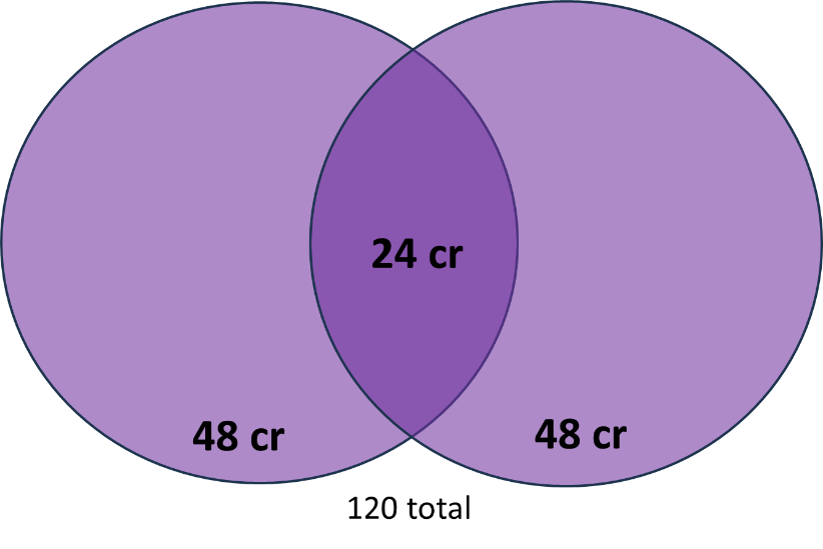
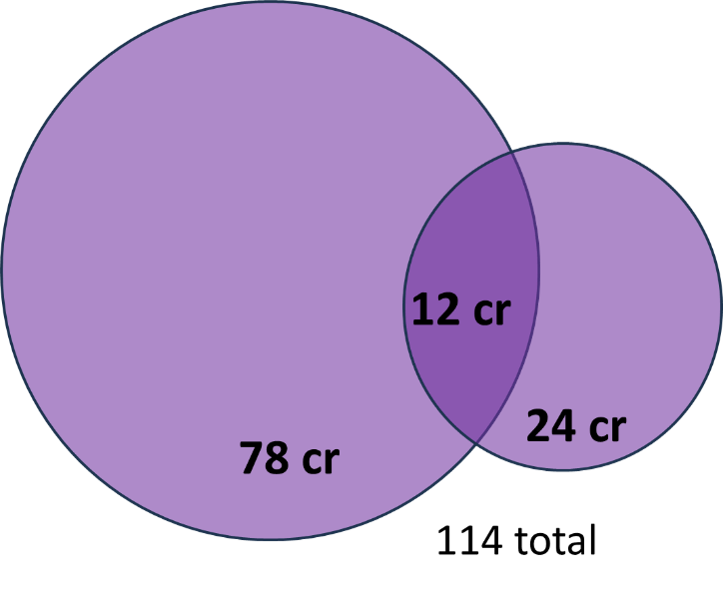
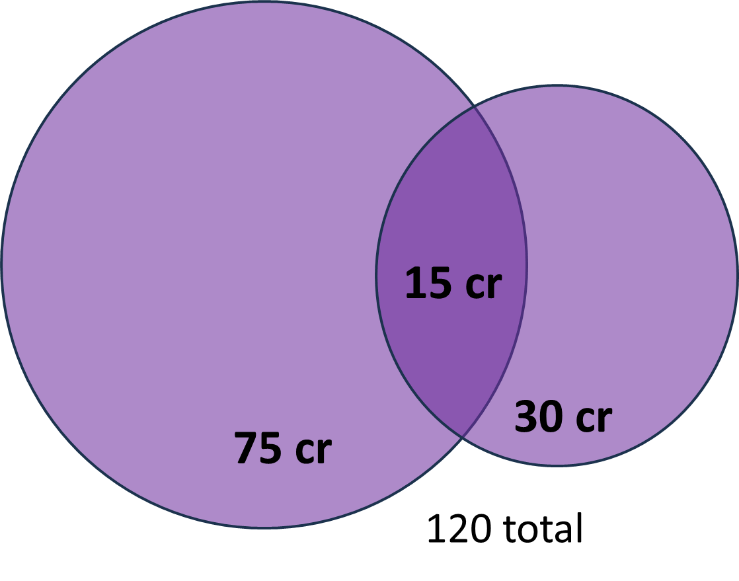
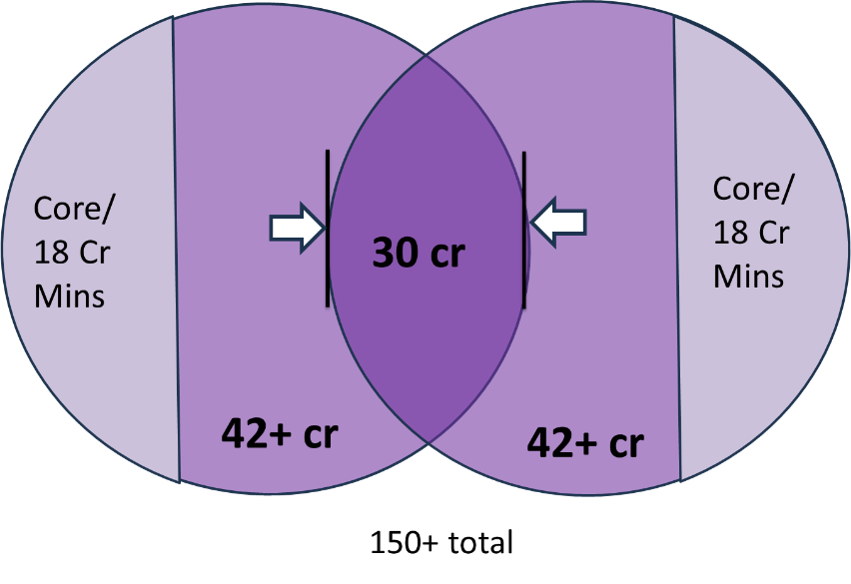
To assist in communicating credit-sharing allowances in concurrent degrees, below you will find a series of Venn diagrams reflecting allowable sharing between degree programs of different types and sizes. These are selected as examples and do not reflect full range of potential combinations.

For each, the circles reflect a degree program’s requirements.  Larger circles represent programs with more requirements.  The overlap between circles reflects the maximum allowable shared credits given the size of the two programs.

Formal or Informal Concurrent Master’s degrees

  • Must combine to 72 credits
  • 60 credits must be unshared (only applied to one degree)
  • Each degree must have 24 credits that are applied only to that degree (these credits could be applied to a certificate).
  • For formal programs, once these minimum conditions are met, there is no maximum limit on shared credits.
  • For informal programs, once these minimum conditions are met, up to 1/3 of requirements for a degree (effectively, the smaller degree) can be shared.

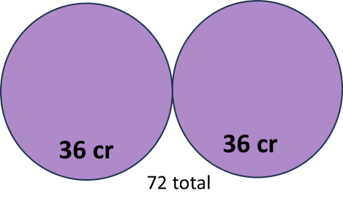
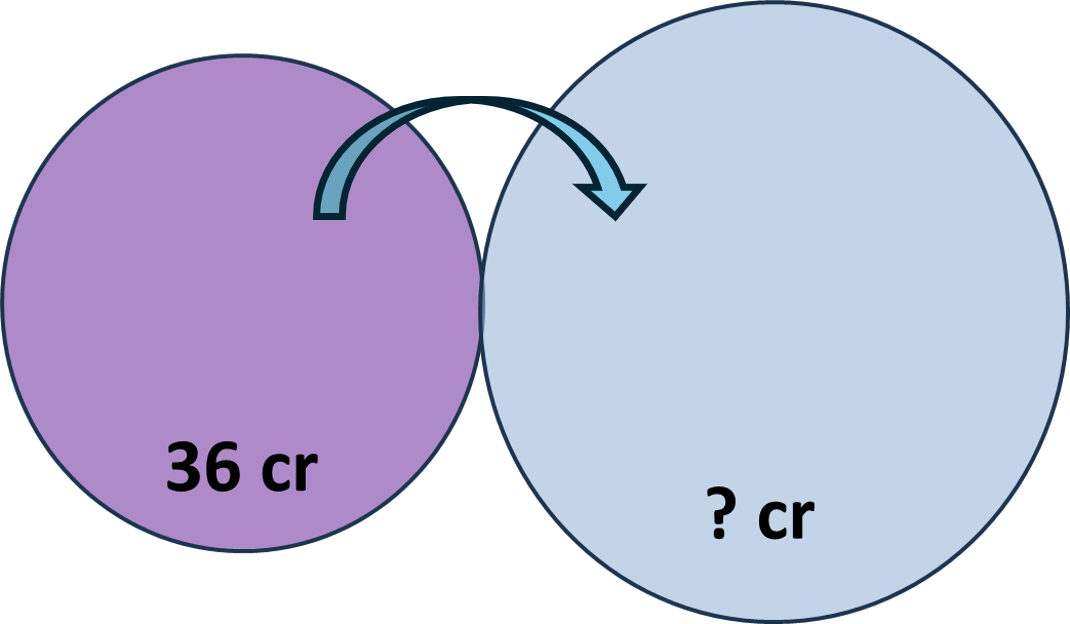
Two 36 Credit Programs (Informal or Formal)

Two adjacent circles, each representing 36 credits.  There is no overlap or sharing of credits because the total number of earned credits must be at least 72

No shared credits allowed to meet 72 minimum credits earned.

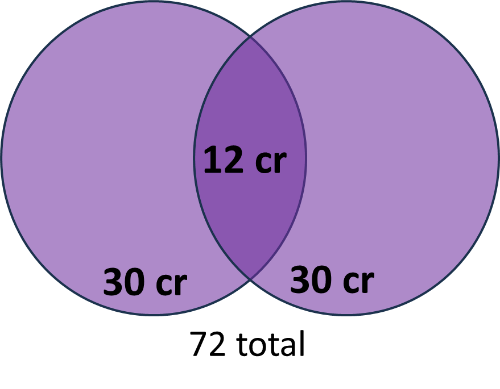
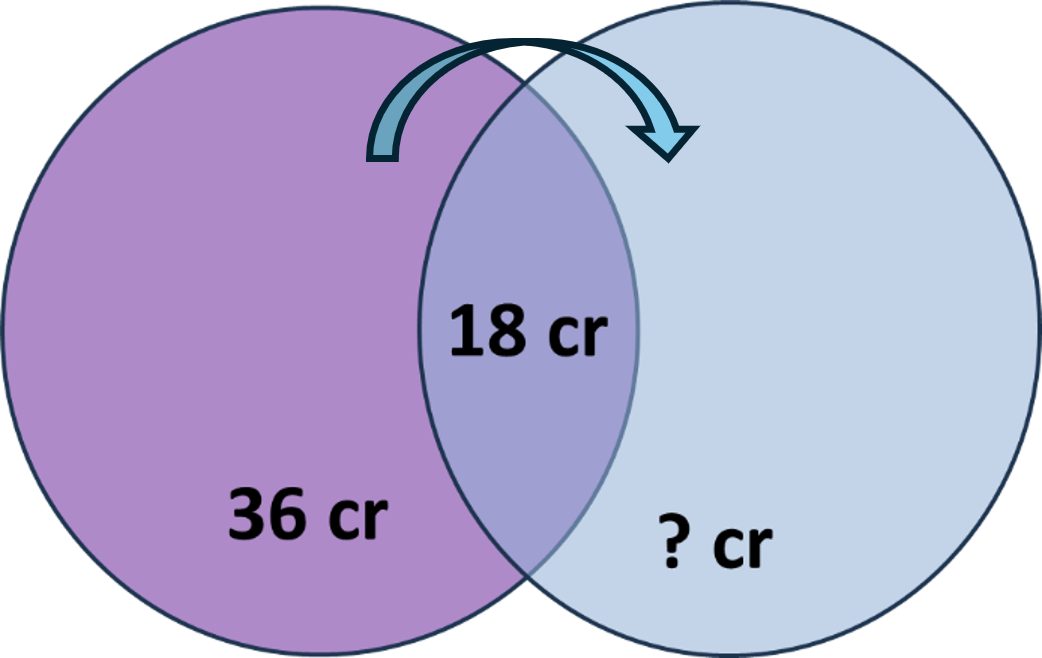
Two 42 Credit Programs (Informal or Formal)

Two overlapping circles, each representing 42 credits.  There is an overlap of 12 credits, since those 12 credits can be shared and the sum of credits still meets the 72 credit minimum

No more than 12 shared credits allowed to meet 72 minimum credits and 60 unshared credits.

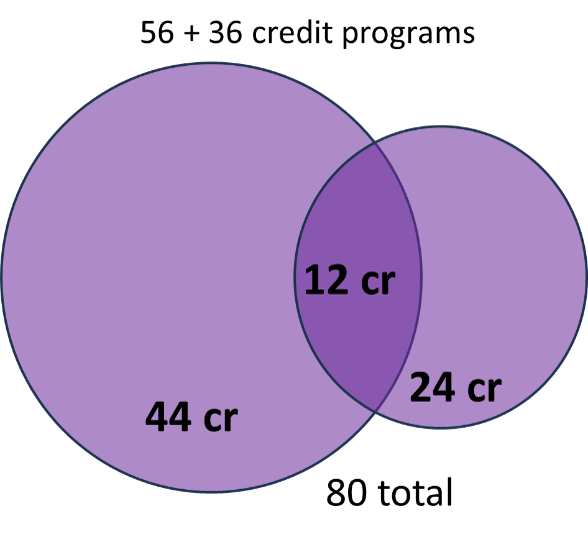
A 56 and a 36 Credit Program (Informal or Formal)

Two overlapping circles, representing 56 and 36 credit programs. There is an overlap of 12 credits as that is the maximum which ensures the smaller program maintains 24 unique credits.

No more than 12 shared credits in order to meet 24 minimum unique credits requirement.

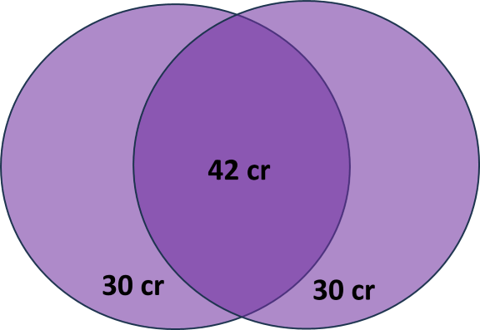
Two 72 Credit Programs (Formal)

Two overlapping circles, each representing 72 credits.  For a formal concurrent program, there is no overall credit sharing limit so long as there are 60 unshared credits.  In this case, 42 credits are shared.

No more than 42 credits shared in order to meet 60 unshared credits requirement.

Two 72 Credit Programs (Informal)

Two overlapping circles, each representing 72 credits.  For an informal concurrent program, up to 1/3 of credits can be shared so long as there are 60 unshared credits.  In this case, 24 credits are shared.

No more than 24 credits shared to remain under the 1/3 maximum credits shared requirement.

Formal or informal concurrent doctoral and master’s programs.

36 credit master’s and 90+ credit doctoral program

Two overlapping circles, one representing a 90-credit doctoral program and the other representing a 36-credit master's program.  The is a 12-credit overlap, since up to 1/3 of the master's program can be credits from a doctoral course of study in another program.

No more than 12 shared credits in order to remain under the maximum of 1/3 of required master’s credits shared with doctoral program.

45 credit master’s and 90+ credit doctoral program

Two overlapping circles, one representing a 90-credit doctoral program and the other representing a 45-credit master's program.  The is a 15-credit overlap, since up to 1/3 of the master's program can be credits from a doctoral course of study in another program.

No more than 15 shared credits in order to remain under the maximum of 1/3 of required master’s credits shared with doctoral program.

Concurrent Research and Practice Doctorate

Two overlapping circles representing the amount of overlap allowed for a research and practice doctorate programs

Maximum 30 credits shared.  Core curriculum and 18 graded and 18 400/500 level course minimums cannot be shared.

Professional degree (blue) and graduate degree (purple; formal)

36 credit Master’s degree and Professional degree

Two adjacent circles representing a professional program and 36 credit master's program.  36 credits must be earned in the graduate program, so no professional credits apply.  It is up to the professional program to determine how many of the 36 graduate credits apply to their professional degree.

Minimum of 36 credits must be earned with graduate courses.  However, professional degree programs can apply those graduate courses to their degrees.

54 credit Master’s degree and Professional degree

Two overlapping circles representing a professional program and 54 credit master's program.  36 credits must be earned in the graduate program, so up to 18 credits from the professional program can apply to the master's program.  It is up to the professional program to determine how many of the 54 graduate credits apply to their professional degree.

Minimum of 36 credits must be earned with graduate courses.  Remaining credits (18 in this case) can be earned through professional degree courses. Professional degree programs can apply additional graduate courses toward their degrees.

Guidance (Student Status) – Reinstatement and Re-Entry

A matriculated student previously registered in the Graduate School who has failed to maintain graduate student status (on-leave status or registration) but who wishes to resume studies in their previous graduate program must submit a reinstatement request to the Graduate School.

This includes:

  • Reinstatement- for students returning to a graduate degree program
  • Re-Entry- for students returning to a graduate certificate program or stacked degree with a certificate component

Students enrolled in both a degree and certificate program must submit separate requests for each program.

For complete details regarding the on-leave, continuous enrollment and reinstatement policies, refer to Graduate School Policy 3.5: On-Leave, Reinstatement, and Re-Entry.

Eligibility

Accessible Accordion

  • Must be an inactive matriculated graduate student wishing to return to their previous degree program. Non-matriculated, undergraduate, or active graduate students are not eligible for reinstatement.
  • Must have been registered for at least one quarter of graduate study at the UW.
  • Must have approval from the graduate program to reinstate or re-enter.
  • Must satisfy any additional graduate program policies about reinstatement/re-entry.
  • International students must have confirmation from the International Student Services office that an I-20 can be issued in time to meet registration deadlines.
  • Students must be within their program’s time-to-completion limits. See the Graduate School policy based on certificates and/or degree level.

Students who do not meet these requirements are not eligible for reinstatement/re-entry without a petition from their graduate program. Ineligible students should instead submit a new application for admission after consulting with their graduate program. Please note that students who meet reinstatement requirements but instead submit a new degree application for admission will have their application fee refunded and be assessed the $250 Reinstatement Fee.

Step 1: Student Action

    1. Consult with your graduate program advisor before starting a request to confirm eligibility and any internal departmental requirements.
    2. Choose the quarter of return with your program. Students may request the current academic quarter or the next academic quarter.
    3. Submit the online Request for Reinstatement (degree programs) or Re-Entry (certificate programs) through MyGrad Program, Reinstatement/Re-Entry Portal*.
      • You will receive a confirmation email once your request has been submitted.

Step 2: Department Action

  • The graduate program reviews your request to determine eligibility.
  • If approved, the department submits its approval in MyGrad Program.
  • You will receive a confirmation email once departmental approval is complete.

Step 3: Student Action (Payment- Degree Programs Only)

  • If you are requesting reinstatement to a degree program, return to MyGrad Program to pay the $250 Reinstatement Fee via MasterCard or Visa.
  • You will receive a confirmation email once payment is received.
  • The reinstatement fee must be paid no later than 11:59:59 p.m. PST on the last day of instruction to be reinstated for the requested quarter.
  • No fee is required for re-entry to certificate programs.

Step 4: GEMS/Graduate School Action

  • The Graduate School (GEMS) processes the approved reinstatement or re-entry request (weekdays only, excluding UW holidays).
  • You will receive a confirmation email once your request has been processed and your registration status for the quarter is active.

Step 5: Student Action

  • Register for the quarter of reinstatement or re-entry to maintain active student status.
  • Update your contact information in the MyUW Student Directory.

Note: If returning to both a degree and certificate program, submit a separate request for each.

Important Notes

  • A valid UW NetID and password are required to access MyGrad and submit requests. 
  • Requests must be submitted separately for each program
  • Reinstatement requests for degree programs require a fee once approved. 
  • Re‑Entry requests for certificate programs do not require a fee

Contact & Support

For questions about:

  • Eligibility, requirements, or department approval → Contact your Graduate Program Advisor (GPA/GPC) first. 
  • International student status (F-1/J-1) → Contact International Student Services (ISS) at iss.washington.edu or 206-221-7857. 
  • Financial aid or loan deferment → Contact the Office of Student Financial Aid at finaid.uw.edu or 206-543-6101.  
  • NetID access and password → Contact UW Information Technology (IT) or visit the NetID management site
  • Technical issues with MyGrad or reinstatement/re-entry problems → Email uwgrad@uw.edu or call 206-685-2630. 

Revised January 12, 2026

Guidance (Academic Requirements) – Graduate School Representative (GSR) Eligibility

In order to serve as a Graduate School Representative (GSR), the proposed candidate:

  1. Must be a Graduate Faculty member with an endorsement to chair (check Graduate Faculty Locator).
  2. Must be clear of any conflicts of interest (see below).  The GSR is responsible for ensuring that no such conflicts of interest, or appearance of conflicts of interest, exist, and must attest to this upon request.
Primary Appt. Joint Appt. Affiliate Appt. Adjunct Appt.
Proposed GSR has appt in student’s/committee chair’s dept No No No Yes
Proposed GSR does not have appt in student’s/committee chair’s dept Yes Yes Yes Yes
Proposed GSR has conflict of interest* No No No No

Yes = eligible to serve
No = not eligible to serve

  • Budgetary relationships, personal relationships, or research and/or publication relationships between the GSR and either the student or the committee chair are examples of possible conflicts of interest.

Guidance (Student Status) – Graduate On-Leave Status

Graduate students must maintain graduate student status throughout their graduate program. If you need to take one or more quarters off without registering, you may request on-leave status for each quarter. This prevents loss of graduate student status and avoids the reinstatement/re-entry process. See Graduate School Policy 3.5 for full details.

LOG IN TO MYGRAD TO REQUEST ON-LEAVE STATUS

Who Can Request On-Leave Status

You may request on-leave status if all of the following apply:

  • Your graduate program approves the leave request.  Note that some programs, by program policy, do not approve on-leave status.
  • You were registered or on leave the previous quarter
  • You have completed at least one quarter of graduate study at UW
  • You are not currently registered, graduated, inactive, non-matriculated, or in a visiting student status
  • International students (F-1/J-1) must confirm eligibility with International Student Services

Additional notes:

  • Students in two graduate programs must have both programs approve the request; only one request and one fee is required.
  • Students may drop all courses before the first day of the quarter to become eligible for leave.
  • Students with financial aid, loans, or GAIP insurance should consult the Office of Financial Aid or UW Benefits Office to avoid loss of coverage.
  • Students do not need to be registered to maintain graduate student status in Summer and on-leave status is not available.  Students in programs that require summer work should contact their program if they require a pause in study.

What On-Leave Status Provides

Status You Keep You Lose
On-Leave UW email, library access, very limited faculty and staff counsel/resources, Hall Health Primary Care Center (pay-for-service basis), IMA (UW Seattle campus students only, extra fee) Most faculty advising/resources, exam privileges, thesis/dissertation filing, university housing, student insurance, financial assistance

Students not registered in summer maintain the same privileges as students in on-leave status.

How to Request On-Leave Status

  1. Log in to MyGrad and click “Request Leave”.
  2. Review leave requirements before starting the request.
  3. Submit your request in MyGrad (opens two weeks before the quarter starts).
  4. Obtain departmental approval (both programs if enrolled in two).

    • If your department approves, you will receive an email notification from the Graduate School with instructions and the deadline.
    • If your department does not approve, contact your graduate program advisor for next steps.

  5. Pay the $25 non-refundable fee via MyGrad by the deadline.

    • Military personnel with deployment orders must still log in and click “Pay” after approval but you will not be charged.

  6. Receive email confirmation for your records.

Multi-Quarter Requests:

  • Peace Corps, military deployment, UW Fulbright, or Bonderman fellows may request up to three consecutive quarters.
  • Fees: $25 per quarter (e.g., $50 for two, $75 for three)
  • Summer quarter: no fee required.
  • Military with deployment papers: no fee required.

Deadlines & Reminders

  • Request opens: Two weeks before the first day of instruction each quarter
  • Student request deadline: 5:00 p.m. PST, last day of instruction (one week before quarter end).
  • Early requests: Students are encouraged to submit their requests 5 business days before the first day of classes to better ensure that they can register for credits if their request is denied.
  • Department approval deadline: 5:00 p.m. PST, last day of the quarter

  • Payment deadline: 5:00 p.m. PST, last day of the quarter
  • Loan deferment: Complete the request and pay by the 2nd Friday of the quarter to stay eligible for loan deferment reporting.
  • Incomplete Requests: Requests not paid or approved by the deadline will be withdrawn automatically. You must request reinstatement and/or re-entry to return.

Reinstatement & Re-Entry

If you did not maintain graduate status (no registration or complete the on-leave status process in full with approval):

  1. Request reinstatement (degree programs) and/or re-entry (certificate programs) through your department
  2. Pay the reinstatement fee to the Graduate School, only for degree programs.

Students enrolled in both degree and certificate programs must submit separate requests for each program.

For more information, see Reinstatement & Re-Entry.

Contact & Support

For questions about:

  • Eligibility, requirements, or department approval → Contact your Graduate Program Advisor (GPA/GPC) first. 
  • International student status (F-1/J-1) → Contact International Student Services (ISS) at iss.washington.edu or 206-221-7857.
  • Financial aid or loan deferment → Contact the Office of Student Financial Aid at finaid.uw.edu or 206-543-6101. 
  • Technical issues with MyGrad or leave payment problems → Email uwgrad@uw.edu or call 206-685-2630. 
  • Reinstatement after missing deadlines → Contact your graduate program first, then the Graduate School if needed. 


Revised October, 2025, April 2026

Policy 5.2: Conditions of Appointment for TAs who are not Native Speakers of English

Current Policy – Until Autumn 2026

[Revisions to Policy 5.2 have been approved and will be effective in Autumn 2026; New language can be found at the bottom of this page]

As stated in Section 3 of Executive Order 28 and Policy 5.1, the University expects that newly appointed Teaching Assistants (TAs) receive appropriate training, supervision and support. Graduate students who are not native speakers of English as indicated in the applicant profile may be appointed as TAs with teaching duties if the student fulfills the three requirements below.

Teaching duties are defined as direct interactions with students for instructional issues. Examples include: holding office hours; reviewing test or paper scores with students; working with students one-to-one in study centers, such as writing, mathematics, chemistry, etc.; tutoring; conducting labs; leading discussions; helping students solve problem sets; commenting on studio work; lecturing.

5.2.1     Requirements

The following requirements must be satisfied before receiving the graduate appointment with teaching duties.

1. Meet the English language proficiency (ELP) requirement as stated in Policy 3.2.

2. Meet the additional spoken English language proficiency requirement in one of the five following ways:

  • Hold a bachelor’s degree from a regionally accredited institution in the United States, or hold a bachelor’s degree from an institution in Australia, the Bahamas, Canada, Ireland, Jamaica, Kenya, New Zealand, Singapore, South Africa, Trinidad and Tobago, or the United Kingdom, where English is the medium of instruction. While enrolled at the degree-granting school, the student must be in residence on campus. (Note: A master’s degree does not satisfy this requirement).
  • Hold a Doctor of Philosophy (PhD) or Juris Doctor (JD) from a regionally accredited institution located in the United States where English is the medium of instruction.
  • Demonstrate spoken English proficiency with a test score on file at the University of Washington of at least:
    • 5.0 (26 for tests taken before Jan 21, 2026) on the speaking section of the TOEFL-iBT (Test Center or At-Home version)
    • 7.0 on the speaking section of the IELTS (Test Center or At-Home version)
  • Pass a one-time appeal interview.
    • For students who have been offered or accepted admission and who have satisfied the recommended English proficiency requirements as stated in Policy 3.2, a graduate program can submit an online request for a one-time appeal interview if the student meets one of the following prerequisites:
      • 4.5 (23 for tests taken before Jan 21, 2026) on the speaking section of the TOEFL-iBT on file with the UW.
      • 6.0-6.5 on the speaking section of the IELTS on file with the UW.
      • 125 on the speaking or conversation section of the Duolingo DET on file with the UW
    • An appeal candidate must receive an overall score of 34 (out of a possible 45) points to pass and be immediately eligible to assume TA responsibilities without taking ENGL 105. Appeal scores expire after two years.
  • Pass English 105. This course is designed specifically for International Teaching Assistants (ITAs) and is offered by UW’s Academic English Program (AEP). While a student is completing English language proficiency requirements, that student can be assigned teaching duties that do not include direct interaction with students. Such duties can include, but are not limited to, grading, setting up labs, preparing instructional materials, running equipment in classrooms.

3. TAs who are not native speakers of English as indicated in the applicant profile and do not hold a bachelor’s degree from a regionally accredited institution in the United States are required to participate in additional TA-specific training from the Center for Teaching & Learning prior to the TA appointment. See the Center for Teaching and Learning’s Teaching@UW: Strategies for TAs for details.

5.2.2     Exceptions

An academic unit teaching modern spoken languages may apply to the Graduate School for a program-level waiver to #2 under Policy 5.2.1 that may be used for specific graduate students enrolled in a doctoral program when the following two conditions are met:

  • the teaching assistant’s teaching duties are conducted exclusively in a non-English target language of the academic unit
  • the teaching assistant is a native speaker of the language of the assigned courses. Requirements #1 and #3 of the general policy must still be met.

[Waivers are requested through Slate under the “Other” option.]


Policy 5.2, effective Autumn 2026

Washington State Law (RCW 28B.15.792) requires that undergraduate students be taught by a person fluent in both spoken and written English language.  As such, graduate students assigned teaching duties, defined as direct interactions with students for the purposes of instruction, must demonstrate English language fluency.

Graduate-level reading and writing proficiency in English is established through the admissions process in accordance with Graduate School Policy 3.2 English Language Proficiency Requirements. The requirements below focus specifically on the additional spoken English proficiency necessary for teaching duties that involve real-time interaction with undergraduate students.  

The requirements below establish Graduate School minimum standards. Hiring departments retain the authority to set higher or more specific requirements, including additional evaluation of reading and writing skills, based on the instructional needs of the course. Any additional requirements must be documented and based on measurable components of English language proficiency.

[NOTE: Examples of teaching duties include: holding office hours; reviewing test or paper scores with students; working with students one-to-one in study centers, such as writing, mathematics, chemistry, etc.; tutoring; conducting labs; leading discussions; helping students solve problem sets; commenting on studio work; lecturing.]

5.2.1     Requirements

Graduate students who are not native speakers of English as indicated in the applicant profile (see Policy 3.2) may be appointed as TAs with teaching duties only if the student fulfills the three requirements below:

1. Meet the English language proficiency (ELP) requirement, without conditions, as described in Policy 3.2.2. Test scores used to meet this requirement must be at the “Recommended” level or higher.

2. Meet the additional spoken English language proficiency requirement in one of the five following ways:

  1. Hold a bachelor’s degree from an regionally accredited institution in Anguilla, Antigua and Barbuda, Australia, the Bahamas, Barbados, Belize, Bermuda, Cayman Islands, Canada, Dominica, Ghana, Grenada, Guyana,  Ireland, Jamaica, Kenya, Liberia, Montserrat, New Zealand, Nigeria, Saint Kitts and Nevis, Saint Lucia, Saint Vincent and the Grenadines, Singapore, South Africa, Trinidad and Tobago, Turks and Caicos Islands, United Kingdom, the United States, or the Virgin Islands, where English is the medium of instruction. While enrolled at the degree-granting school, the student must have been in residence in the English-speaking country. 
  2. Hold a Doctor of Philosophy (PhD) or Juris Doctor (JD) from a regionally accredited institution located in the United States where English is the medium of instruction.
  3. Demonstrate spoken English proficiency with a test score on file at the University of Washington of at least:
    • 5 (or 26 for exams taken prior to January 21, 2026) on the speaking section of the TOEFL-iBT (Test Center or At-Home version)
    • 7.0 on the speaking section of the IELTS (Test Center or At-Home version)
    • 140 on the Duolingo English Test (DET) Conversation score. [Note: Less than 10% of DET test takers receive a 140 or above; 2025 data from DuoLingo]
  4. Pass a one-time spoken English proficiency assessment with UW staff.
    • For students who have been offered or accepted admission and who have satisfied the recommended English proficiency requirements, without conditions, as stated in Policy 3.2.2, a graduate program may submit an online request  for a one-time spoken English proficiency assessment if the student meets one of the following prerequisites:
      • 4.5 (or 23-25 for exams taken prior to January 21, 2026) on the speaking section of the TOEFL-iBT on file with the UW.
      • 6.0-6.5 on the speaking section of the IELTS on file with the UW.
      • 125 on the speaking or conversation section of the Duolingo DET on file with the UW.
      • The completion of an undergraduate or graduate degree at a university where English is the medium of instruction.
    • A candidate must receive an overall score of 34 (out of a possible 45) points to be immediately eligible to assume TA responsibilities without taking ENGL 105. Assessment scores expire after two years.
  5. Pass English 105. This course is designed specifically for International Teaching Assistants (ITAs) and is offered by UW’s Academic English Program (AEP). While a student is completing spoken English language proficiency requirements, that student can be assigned teaching duties that do not include direct interaction with students. Such duties can include, but are not limited to, grading, setting up labs, preparing instructional materials, and running equipment in classrooms.

3.  TAs who are not native speakers of English as indicated in the applicant profile and do not hold a bachelor’s degree from a regionally accredited institution in the United States are required to participate in additional TA-specific training from the Center for Teaching & Learning prior to the TA appointment. [Note: See the Center for Teaching and Learning’s Teaching@UW: Strategies for TAs for details; this training is recommended for all TAs.]

5.2.2     Exceptions

An academic unit teaching modern spoken languages may apply to the Graduate School to waive requirement #2 under Policy 5.2.1 for specific graduate students enrolled in a doctoral program when the following three conditions are met:

  • The teaching assistant’s teaching duties are conducted exclusively in a non-English target language of the academic unit
  • The teaching assistant is a native speaker of the language of the assigned courses
  • Requirements #1 and #3 under Policy 5.2.1 are met.

[NOTE: Waivers are requested as a MyGrad petition under the “Other” option.]


Policy 5.2 revised: December 2021

Policy 5.2.1, section 3 revised: February 2023

Policy 5.2 and 5.2.1 revised: August 2023

Policy 5.2.1 revised February 2024, February 2025

Policy 5.1: Departmental Responsibilities Regarding Instruction by TAs

Ensuring the quality of instruction offered by UW Teaching Assistants is not solely the responsibility of individual TAs, but also involves responsibilities and activities at the levels of the department, the school or college, the Graduate School, and the university.

This policy describes and delineates the minimum responsibilities that the Graduate School expects of departments for supporting and assessing instruction by TAs during the first two quarters of teaching, and makes explicit the methods by which TAs and the TA’s students can provide input to these processes.

5.1.1     Departmental Procedures

  • Training and supervision: In keeping with Executive Order 28, all TAs are to receive appropriate training and close faculty supervision while performing TA duties.
  • For TAs assigned to labs, studios, study centers, quiz sections, and those who teach their own courses, supervision is to include at least one observation by supervising faculty as early as possible during each of the TA’s first two quarters of teaching at UW. The purpose of this observation is to confirm that TAs are teaching content competently, to provide guidance regarding content, presentation, and student involvement, and to assess TAs’ needs for further training or assistance. Criteria for teaching competence and procedures for observations are to be determined by each department.
  • If the observer concludes that the TA is not meeting departmental criteria for teaching competence, then supervising faculty will work with the TA to determine a specific, written plan for addressing the TA’s teaching difficulties. To the extent that funding permits, possible options include:
    • Increase training, observation, and/or supervision by a faculty member or experienced TA mentor.
    • Refer the TA to the Center for Teaching and Learning for instructional consultations.
    • Employ a more experienced teacher to team teach with the TA.
    • In exceptional cases where other responses cannot adequately address the issues that have been identified, re-assign the TA to another role. Acquire a more experienced teacher to fill the role from which the TA was removed, and provide additional training to prepare the TA for re-assignment during subsequent quarters.

Supervising faculty should follow up on the specific plan during that quarter, and at the end of the quarter, should confirm the extent to which the plan was followed and what results were achieved.

5.1.2     Informing TAs of Departmental Procedures

  • Criteria for teaching competence and procedures for observations are to be determined by each department and are to be communicated to the TA prior to the observation, at the beginning of the quarter. Departments are also to specify procedures by which TAs can give input to the observation process, and if they choose, appeal the outcomes of any decisions based on observations.
  • Reports to TAs in the TA’s first two quarters of teaching: By the end of the fourth week of the following quarter, departments will provide the TA with a report summarizing the TA’s performance of TA duties. Departments are to use departmental forms for these reports.

5.1.3     Informing Students How to Communicate Concerns about TAs

  • In all classes in which TAs are assigned teaching duties, departments are to make explicit to students a policy regarding student responsibilities and specific procedures to follow if they are having trouble working with or understanding the TAs.
  • Teaching duties are defined as interactions with students over instructional issues. Examples of teaching duties include holding office hours, reviewing tests or paper scores/evaluations with students, answering questions in special centers such as those focused on assistance with writing, math, chemistry, etc., tutoring, conducting labs, leading discussions, assisting students to solve problem sets, commenting on studio work, or lecturing.
  • Departments should also specify the methods by which the policy will be communicated to students (for example, announced by the professor, included on the syllabus, posted in the department and on the web, etc.). The following example illustrates one way a department might choose to communicate with students, bearing in mind the importance of encouraging students to approach the TA first:
    • If you have any concerns about the class or your TA, please see the TA about these concerns as soon as possible. If you are not comfortable talking with the TA or not satisfied with the response that you receive, you may contact (immediate supervisor) in (room number) (building), or at (phone or e-mail).
    • If you are still not satisfied with the response that you receive, you may contact (department chair) in (room number) (building) or at (phone or e-mail.) .
    • For your reference, these procedures are posted on the (name of department) Bulletin Board, next to the Departmental Office in (room number) (building).
  • It is up to departments to determine to what extent departmental communication to students addresses only instruction by TAs, instruction by both TAs and faculty, or broader issues in addition to instruction.

Policy 5.1 revised: January 2000; November 2010; December 2022

Policy 4.2: Supervisory Committee for Graduate Students

The Graduate School, per EO VII, has jurisdiction over the membership of committees charged with supervising advanced course programs and dissertations of students in the various fields of graduate study.

The supervisory committee serves important evaluative and mentoring functions for the student throughout the student’s graduate career. Programs may specify additional requirements of the supervisory committee as described in their program handbook.

Each committee must have a Committee Chair (or Co-Chairs) who is able and willing to assume principal responsibility for advising the student and should have adequate time available for this work and be accessible to the student.

[Note: Questions about the timeline and process for appointing a supervisory committee for master’s or doctoral students should be directed to the Graduate School’s Graduate Enrollment Management Services (GEMS) office. All other questions about supervisory committee appointment or function, as well as concerns about the proceedings of an exam, should be directed to the Graduate School’s Office of Academic Affairs.]

4.2.1     The Master’s Supervisory Committee

Appointment of a supervisory committee for students pursuing the master’s degree is made by the Graduate Program Coordinator (GPC), acting on behalf of the Graduate Faculty of the degree‑offering unit. The GPC approves and appoints the committee in consultation with the student and appropriate Graduate Faculty members.

4.2.1.1 Committee Composition

A master’s supervisory committee must:

  • include at least two members.
  • have at least one‑half of its members drawn from the Graduate Faculty.
  • have a Committee Chair who is a member of the Graduate Faculty.
    • A program can petition to the Office of Academic Affairs to have a non-Graduate Faculty member serve as Committee Chair if: 1) the student’s area of specialization is uniquely supported by the proposed Committee Chair, and 2) one-half of the total committee members are Graduate Faculty.

4.2.2    The Doctoral Supervisory Committee other than Practice Doctorates

The appointment of a doctoral supervisory committee indicates that the Graduate Faculty in the student’s field find the student has developed the skills and knowledge necessary to prepare for their general examination and doctoral research.  It is approved according to the rules and published norms of the program by the Graduate Program Coordinator (GPC) after consultation with appropriate Graduate Faculty members in the student’s field and with the student.

4.2.2.1 Doctoral Committee Responsibilities

Doctoral supervisory committee member responsibilities include the approval of a course of study which will fulfill the general course requirements of the student’s major and supporting fields, conducting the student’s General Examination and, when appropriate, recommending advancement to candidacy.

The doctoral supervisory committee approves the candidate’s dissertation proposal and provides intellectual mentorship supporting the development of the dissertation. The Graduate School does not stipulate the content of the dissertation; guidance on the dissertation is the responsibility of the supervisory committee.

[For doctoral committee responsibilities for the General Exam and Final Exam, see Policy 1.1.4. See also: Guidance (Academic Requirements) – Final Examination: Dissertation DefenseGuidance (Academic Requirements) – Instructions for Virtual Doctoral Examinations, and Guidance (Academic Requirements) – If a Committee Member is Missing]

4.2.2.2      Committee Composition

The doctoral supervisory committee must:

  • include a minimum of four members.
  • include at least three Graduate Faculty members with Doctoral Endorsement, including the Committee Chair and the Graduate School Representative (GSR).
  • have a majority of members who are Graduate Faculty.
  • include members—except the GSR—who are identified by the student’s appointing department or program as productive scholars in the student’s major field and/or subfields

4.2.2.3     The Committee Chair

  • A program can petition to the Office of Academic Affairs to have Graduate Faculty member without Doctoral Endorsement serve as chair if: 1) the student’s area of specialization is uniquely supported by the proposed chair, and 2) one-half of the total committee members have a Doctoral Endorsement.
  • Emeritus and affiliate faculty may serve as Chair(s) if the above conditions are met.
  • If a committee has Co-Chairs, both serve with equal importance on a student’s supervisory committee and equally share the responsibility for the student’s progress. In the case of Co-Chairs, one Co-Chair must have a Graduate Faculty appointment with a Doctoral Endorsement. The other Co-Chair may be appointed without Graduate Faculty status if the individual has a qualified UW faculty appointment. Qualified faculty appointments in this context are those titles eligible for continuous or five-year Graduate Faculty roles (see this document for the list of eligible titles). A Co-Chair without qualified UW faculty appointment may be appointed only by petition through the Office of Academic Affairs to the Dean of the Graduate School or the Dean’s designee.

4.2.2.4     The Graduate School Representative (GSR)

See also: Guidance (Academic Requirements) – Graduate School Representative (GSR) Eligibility

The GSR represents the broad interests of the Graduate School with respect to high standards of scholarly performance. The GSR is a voting member of the dissertation supervisory committee, and as such provides an important service function to the Graduate School and the University.

4.2.2.4.1     GSR Eligibility

The GSR:

  • must be a member of the Graduate Faculty with a Doctoral Endorsement.
  • may have a scholarly area that differs from that of the student’s dissertation project.
  • must not have any actual or perceived conflicts of interest with the student or graduate program. The GSR is responsible for ensuring that no such conflict exists. Budgetary relationships, personal relationships, research and/or publication relationships between the GSR and either the student or the Committee Chair are examples of possible conflicts of interest. Faculty members with a primary, joint, or affiliate appointment in the student’s degree-offering unit or the Committee Chair’s department are not eligible to serve as the GSR.

4.2.2.4.2   GSR Responsibilities

The GSR must meet the following Graduate School requirements:

  • attest to the validity of examinations and indicate approval of the process by which examinations are conducted;
  • ensure that the student is treated in an unbiased manner; and
  • represent the Graduate School in ensuring university-wide standards of scholarly performance.

In addition, any graduate program may choose to further define the role of the GSR to include one or both of the following:

  • ensure that the student’s mastery of the subject matter is broad and comprehensive.
  • serve as a neutral resource to support clarity and fairness as the student navigates the exam and dissertation process.

Any additional expectations for the GSR beyond the Graduate School requirements must be clearly articulated and communicated in writing by the Graduate Program Coordinator (GPC) or designee to all parties (student, chair, committee members, GSR) upon appointment of the GSR. The minimum role of the GSR must be defined consistently across all committees in the graduate program.

The GSR’s signature on the committee signature form affirming the decision of the committee communicates to the Dean of the Graduate School that the Graduate School and program-level responsibilities have been met.

4.2.2.5   The Reading Committee

After the General Examination, the GPC or their delegate informs the Dean of The Graduate School of at least three members of the supervisory committee who will serve on the reading committee. At least one of the members of the reading committee must hold a Doctoral Endorsement.

It is the responsibility of the reading committee to:

  • ensure that the dissertation is a significant contribution to knowledge and is an acceptable piece of scholarly writing.
  • determine the appropriateness of a candidate’s dissertation as a basis for issuing the Committee Signature Form for a Final Examination.

4.2.3  The Practice Doctorate Supervisory Committee

The appointment of a practice doctoral supervisory committee indicates that the Graduate Faculty in the student’s field finds the student has developed the skills and knowledge necessary to complete the requirements of the doctoral program. The GPC initiates the appointment of the committee after consultation with appropriate Graduate Faculty members in the student’s field and with the student.

4.2.3.1 Committee Responsibilities

Responsibilities of the practice doctoral supervisory committee include: approval of the student’s program of study; criteria for progression, which may include a general examination, certification, or other requirements set by the graduate program; approval and oversight of the student’s project proposal; and approval of the completed project.

4.2.3.2 Committee Composition

The practice doctoral committee must:

  • include a minimum of three members.
  • be chaired by a Graduate Faculty member with a Doctoral Endorsement (unless petitioned under the conditions described in 4.2.4.3).
  • include at least one‑half Graduate Faculty members with primary, joint, emeritus, or adjunct appointments in the degree program’s academic unit and holding one of the following titles at any rank: Professor, Professor (WOT), Teaching Professor, Research Professor, Professor of Clinical Practice or Clinical Professor (Salaried).
    • A program can petition to the Office of Academic Affairs to have more than half of their committee be non-Graduate Faculty if 1) the student’s area of specialization is uniquely supported by the expertise of the non-graduate faculty, and 2) the committee is chaired by a Graduate Faculty member with Doctoral Endorsement.
  • have any non-Graduate Faculty members identified by the program as productive scholars or practitioners in the student’s major field and/or subfields.

4.2.3.3 Committee Chair

  • Emeritus faculty may serve as a Chair if they can meet the time and access expectations of the role.
  • A program can petition to the Office of Academic Affairs to have a Graduate Faculty member without Doctoral Endorsement serve as chair if: 1) the student’s area of specialization is uniquely supported by the proposed chair, and 2) at least one committee member is endorsed to chair.
  • Co-chairs may be appointed when both serve with equal importance on a student’s supervisory committee and equally share the responsibility for the student’s progress. One Co-Chair must have a Graduate Faculty appointment with Doctoral Endorsement. The other Co-Chair may be appointed without Graduate Faculty status if the individual has a qualified UW faculty appointment. Qualified faculty appointments in this case are those appointments eligible for continuous or five-year graduate faculty roles. A Co-Chair without qualified UW faculty appointment may be appointed only by petition through the Office of Academic Affairs to the Dean of the Graduate School or the Dean’s designee.

4.2.4 Program Responsibilities in Committee Formation and Maintenance

While students hold primary responsibility for forming and maintaining their supervisory committee, programs are accountable for meeting their own obligations as outlined in the sections below—including providing clear written expectations, proactive advising, and timely documentation—so that students are adequately supported in fulfilling this responsibility.

Programs should strive to admit only the number of students who can be well supported by available faculty who are qualified to serve as supervisory committee chairs and members. Programs are not required to guarantee that a student will be able to work with a specific faculty committee chair or supervisory committee member.

[Note: This policy does not address student funding. Funding offers that are contingent on a student working with specific faculty should clearly state the conditions on which the offer depends.]

4.2.4.1 Interim Faculty Point of Contact

Students must have a faculty point of contact at all times. Once a committee is established, the Committee Chair is the faculty point of contact.

If a student does not yet have a Committee Chair, or if they lose their Committee Chair, they must be assigned an Interim Faculty Point of Contact.  While it is the student’s responsibility to find a Committee Chair, the Interim Faculty Point of Contact plays an essential support role during these periods.

The Graduate Program Coordinator (GPC) must either serve in this role or delegate this responsibility to another faculty member (for example, another member of the committee) who agrees to serve. 

The Interim Faculty Point of Contact:

  • is responsible for assisting the student in registering for research, thesis, or dissertation credits.
  • is responsible for providing good‑faith academic guidance, as needed, to help the student determine whether and how a viable graduate committee can be formed (or re-formed), based on the student’s scholarly objectives, available faculty expertise, and applicable Graduate School and program policies; the Faculty Point of Contact is not responsible for securing a Committee Chair or resolving the absence of one.
  • is not a replacement for a Committee Chair and therefore cannot be required to provide the student with content-specific expertise, review of their scholarly work, or funding.
  • does not fulfill the expectation that students have a complete supervisory committee.

4.2.4.2   Program Responsibilities related to committee formation and maintenance.

As the representatives of their degree programs per Policy 4.3, GPCs, assisted as appropriate by GPAs and/or additional delegates, must:

  • ensure students and committee members receive clear communication about relevant Graduate School policies, including this policy (Policy 4.2: Supervisory Committees) and Policy 4.1 (Membership in Graduate Faculty).
  • provide guidance, including clear written information, about committee formation timelines and any committee composition requirements beyond those in this policy. This includes any expectations related to department membership or the disciplinary expertise of chairs and/or members.
  • ensure committee members, especially those outside of the program (e.g., GSRs) are aware of program-specific committee member responsibilities and expectations.
  • ensure students receive timely communication (e.g., required annual review, quarterly letters as needed) of expectations and available options for progress towards the degree.
  • monitor student progress toward committee formation or re-formation by conducting periodic check- When progress falls behind expected timelines, the program should provide written guidance to the student and identify next steps in a Notification or Academic Alert (per GSP 3.7.3).
  • document when students report difficulties such as patterns of miscommunication, unavailability of faculty with the appropriate scholarly expertise, or personality conflicts that may impede formation or maintenance of a viable committee.
  • consult with their department chair, appropriate school, college, or campus administrator and/or the Graduate School’s Associate Dean of Student Success. The Civil Rights Compliance Office should be consulted in circumstances where harassment, bullying or other types of unprofessional behavior are claimed as issues preventing the formation or maintenance of supervisory committee or appointment of the chair.

4.2.4.3  Unsatisfactory Progress in Supervisory Committee formation.

Failure to establish or maintain a supervisory committee by the program’s required deadline must be documented with clear expectations for committee composition and due dates and an opportunity for the student to resolve the issue through the processes described in Policy 3.7.3: Unsatisfactory Performance and Progress Documentation. This includes at least two quarters of documentation and communication with the student, consisting of an Academic Alert followed by a Final Academic Alert, before the Graduate School will consider an Academic Drop. Expedited procedures under GSP 3.7.5 cannot be applied when the only documented issue is the lack of a complete supervisory committee, except in the following circumstance:

  • Programs with lab rotations or similar models in which students are expected to find a chair or committee by an established date can issue either an Academic Notification or Academic Alert at least two quarters prior to the due date before issuing a Final Academic Alert in the quarter prior to the due date if they plan to Academically Drop students who have not identified a chair/committee. This process must be documented in student-facing materials such as the student handbook.

4.2.5 Responsibility of the supervisory committee chair in research involving human or animal subjects

For any thesis or dissertation project that may include human or animal subjects, the GPC or GPA must advise the student of the need to comply with the University of Washington Human Subjects Division and Institutional Animal Care and Use Committee’s requirements, as appropriate.  The program should maintain documentation that the committee chair and students have been so advised.


    Policy 4.2 revised: October 2021, March 2022; May 2022; December 2022, October 2023, January 2025, May 2026 

    Policy 4.2.3.1 revised February 2025

    Policy 4.2.1 and 4.2.3 revised March 2023

    Policy 4.2.3.6 and 4.2.4 revised March 2023

    Policy 4.2.3.7 and 4.2.3.9 were deleted March 2023, with content moved to Policy 1.1

    Policy 4.2.4 added May 2026