Connecting code and culture
Blending literature and computer science, Ph.D. candidate Rijul Jain will study at Cambridge University for 9 months after receiving the prestigious Gates Cambridge Scholarship.
Growing up in Silicon Valley, Rijul Jain was always in close proximity to technology and its influence over society. Technology can shape how we think, live and understand the world around us. At the same time, another lifelong passion was taking shape: language and literature. Through literature and great teachers, he discovered a second way of seeing — one that prized nuance and human complexity. What began as two separate intellectual loves would eventually become the central question of his academic life: how can computing and the humanities remain distinct in their power, yet meaningfully inform one another?
"My academic interest was never just about technology or language in itself. I had the sense, rather, that there was some crucial possibility of bridging the gulf between thought and action missed in the sciences and humanities never truly speaking to each other.”
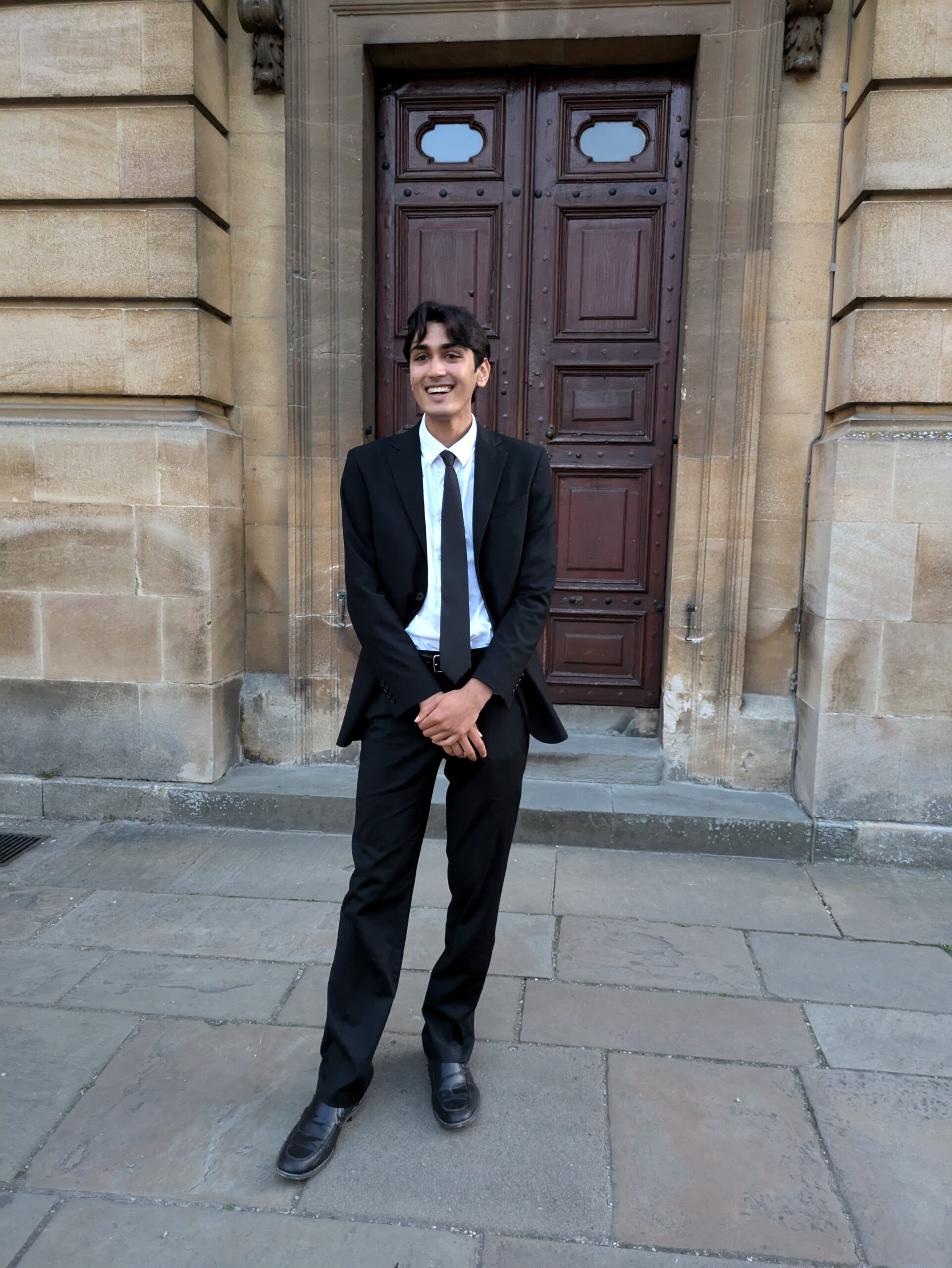
Rijul Jain standing near the Sheldonian Theatre in Oxford, UK.
Interdisciplinary vision
During his undergraduate education at Williams College, he dove deeper into the workings of literature. The humanities, he learned, possess their own conceptual power–one that can address the blind spots of scientific knowledge in describing people, society and reality itself. He began asking whether humanistic and scientific fields could intersect without sacrificing their respective intellectual integrity.
“I didn’t find a satisfactory connection in existing approaches in terms of preserving the force of thought of both disciplines,” Jain says. “I was just trying even to formulate the proper questions to do justice to this problem, which, I had heard, is precisely what a Ph.D. is for.”
This led Jain to start applying to graduate schools. He spent a summer in Seattle interning for Microsoft Research and quickly fell in love with the city. His desire to stay and pursue a Ph.D. led him to apply to the University of Washington Paul G. Allen School of Computer Science and Engineering and become a recipient of the National Science Foundation Graduate National Research Fellowship Program (NSF GREP). He entered with a clear ambition: to examine the computing dimensions of urgent questions facing the arts and humanities.
Digital collections in art institutions and humanities departments, he explains, are not just technical systems; they are sites of interpretation. How should computing research in these spaces be shaped by humanistic inquiry? What does it mean to build digital tools that respect the complexity of cultural memory?
Jain is co-advised by Benjamin Charles Germain Lee, who has collaborated with the Library of Congress and the U.S. Holocaust Memorial Museum in his research on AI-powered archival search, in the Information School and R. Benjamin Shapiro, an AI and computing education researcher trained as a learning scientist, in the Allen School.
“Finding two incredible advisors with these methodological backgrounds has enabled me to take up questions in which I’ve always been interested and refine them in the computing context,” he says. “How can we genuinely represent the past? How can and do we access the past? And now, how can computing research, informed by the humanities and the learning sciences, intervene practically in the digital aspects of these questions?”
These questions have shaped Jain’s current research. Today’s digital collections—library catalogs, archival databases and large-scale repositories—are often built for general use. But humanities scholars, archivists and arts professionals approach materials with highly specialized methods and research questions.
In his first year as a Ph.D. student, Jain has focused on collaboratively designing alternative search interfaces for digital archival collections. Working directly with librarians, archivists and humanities researchers, he is helping rethink how discovery systems can better reflect the needs and values of the communities they serve.
The Road to Cambridge
His intent to blend humanistic and computing work led Jain to apply to the Gates Cambridge program. Each year Gates Cambridge offers full-cost scholarships to outstanding applicants from countries outside the UK to pursue a postgraduate degree in any subject available at the University of Cambridge. Jain discovered the Gates Cambridge program during his senior year. When two of his classmates at Williams were selected the year before, the opportunity suddenly felt tangible—and deeply compelling.
He knew he wanted to study literature at Cambridge, drawn by the promise of immersive archival work and the unparalleled resources of its libraries and museums. Yet what truly resonated was the scholarship’s emphasis on social impact.
“I wanted to articulate this cross-disciplinary academic vision to myself in a way that wasn’t just for its own sake, that had actual social impact,” Jain says. “The Gates mission seemed to align really well with that.”
The application process demands more than academic excellence. Additional application essays and an interview also call for Gates Cambridge applicants to demonstrate strong reasons for choosing their particular course of study, leadership capabilities and a commitment to improving lives.
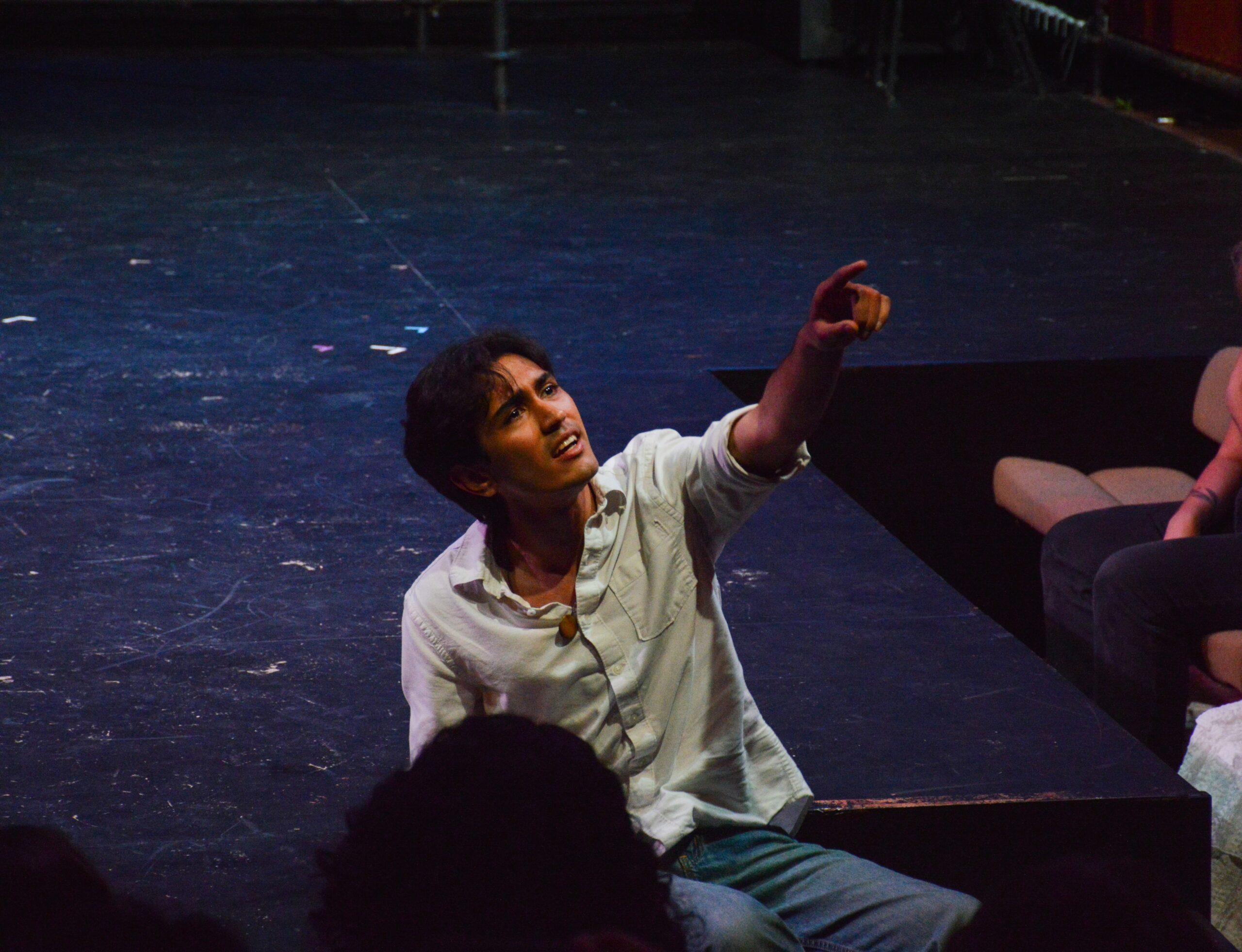
During his interview, he proposed to study the Victorian realist novel, focusing on George Eliot and the critic John Ruskin, examining how both grappled with representing the Italian Renaissance. At first glance, the project might seem distant from his computer science trajectory. But for Jain, the connection is fundamental.
“The problems of historical reception and representation they’re thinking through are even more urgent for us today, especially in the digital realm,” he maintains.
Through the Master of Philosophy in English Studies, Jain aims to gain hands-on experience with archival and material scholarship. That grounding, he believes, is essential preparation for his long-term goal: improving search, access and interpretation across large-scale digital collections during his computer science Ph.D.
With AI rapidly transforming how institutions manage information, museums, libraries and academic archives face urgent questions about access and scale. Jain wants to build computational tools that will support these spaces.
“Cambridge will enable me to undertake my computing Ph.D. work in a more grounded way,” Jain says. “How can I serve the arts and humanities if I’m not a humanist first?”
For Jain there is no choosing between English and computer science. His work is about weaving them together, using humanistic insight to guide technological innovation and ensuring that digital representations of history remain thoughtful, contextual and genuinely useful.
By: Tatiana Rodriguez, UW Graduate School
Published on March 02, 2026