Coastal Resilience
From Construction Sites to
Coastal Resilience: Dakota Mascarenas’
Path to Impact-Driven Engineering
Dakota Mascarenas did not begin her academic career with a clear vision of becoming a researcher focused on coastal hazards and climate resilience. In fact, her path to engineering was anything but linear. After starting her undergraduate studies with a completely different plan, Mascarenas eventually found her way into civil engineering—an experience she describes as “stumbling into it,” but one that would ultimately shape her career.
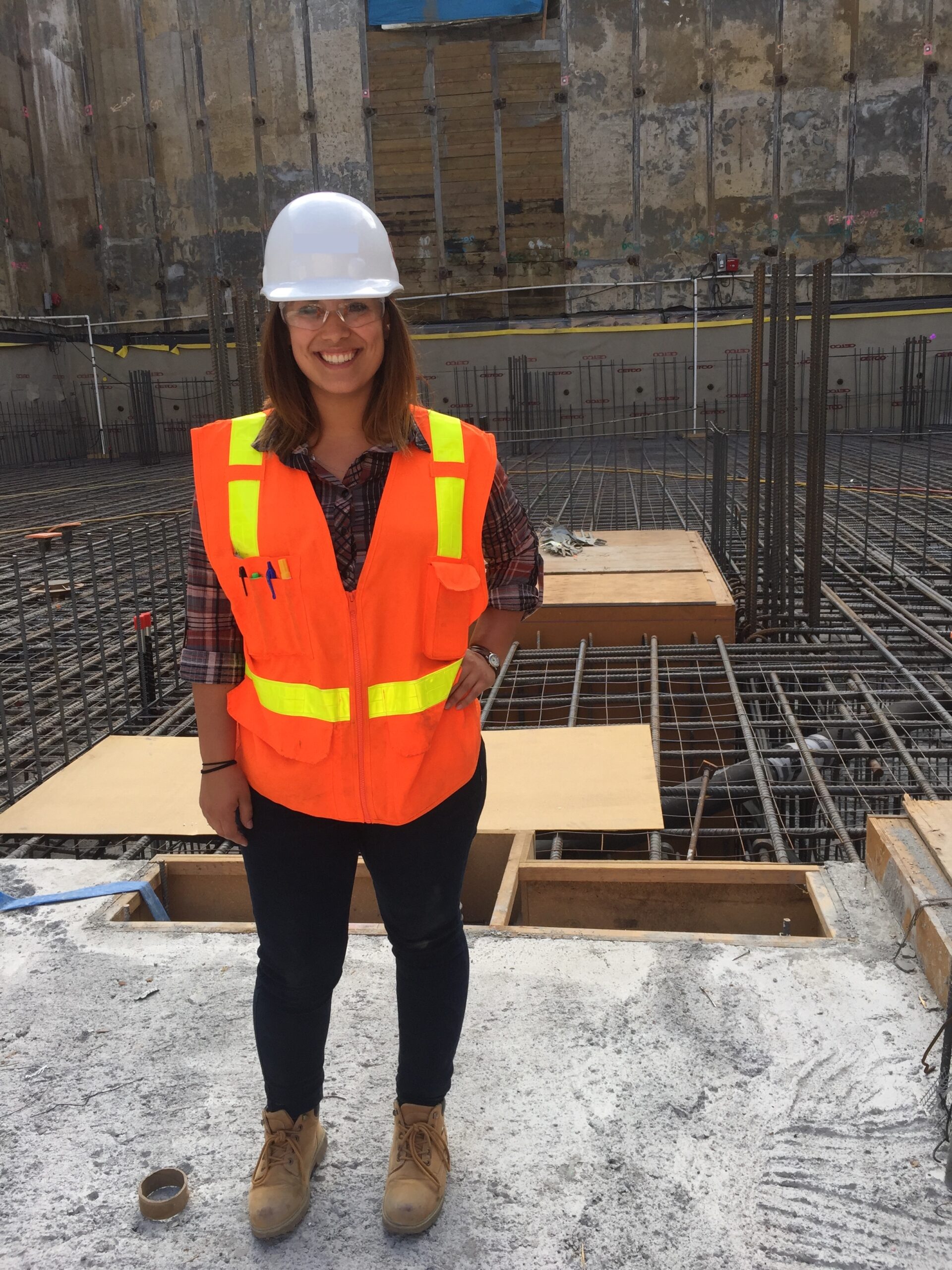
Mascarenas earned her undergraduate degree from Stanford University, where she built a strong technical foundation in civil engineering. After graduation, she spent several years working for general contractors in the San Francisco Bay Area. As a project engineer, Mascarenas gained firsthand exposure to the construction industry—often as the only young woman on the job site.
“That was an experience,” Mascarenas says, “While the work was fast-paced and provided a crash course in how the industry operates, it also clarified what I didn’t want in a long-term career.” The lack of progressiveness in the field and the intensity of the work environment prompted her to start asking where – and how – she wanted to make an impact
Quakes and Tsunamis
With an interest in natural hazards and a growing curiosity about research, Mascarenas applied to graduate school at the University of Washington. Although she entered the process with limited exposure to academia, UW immediately stood out. She was drawn to Seattle and intrigued by the Pacific Northwest’s exposure to earthquakes and tsunamis; Mascarenas enrolled in a research-based master’s program in structural engineering within the Department of Civil and Environmental Engineering.
At UW, Mascarenas joined Professor Mike Motley’s research group and began working on tsunami-resilient structural design. Their research focused on a critical but often overlooked aspect of tsunami damage: debris. During major tsunami events, structures, trees, and other objects can be swept up by powerful waves and become destructive projectiles. Mascarenas’s work examined how this debris is transported within tsunami flow and how it interacts with coastal structures: insights that can directly inform safer, more resilient design practices.
This research took Mascarenas beyond the classroom and into large-scale experimental work at Oregon State University’s NHERI wave laboratory. There, she led experiments using massive wave generators to simulate tsunami conditions and observe how debris fields interact with test structures. Conducted during the height of the COVID-19 pandemic, the work required a high degree of independence and adaptability.
“It was deep COVID,” recalls Mascarenas, “Much of the experimental work was done with minimal personnel support.” The experience proved formative, offering hands-on insight into experimental research and reinforcing her interest in hazard-focused engineering.
Although Mascarenas initially transitioned seamlessly from a master’s program into a Ph.D. track, she ultimately decided not to continue her doctoral work in structural engineering. While completing her master’s thesis, she began exploring other research directions within civil and environmental engineering, seeking work that aligned more closely with her values and long-term goals. That search led her to coastal engineering and the environmental fluid mechanics (EFM) group at UW.
Positive Report
Mascarenas was focused on using her time in graduate school to maximize positive impact—particularly at the local level. Issues like climate change, environmental health, and the vulnerability of coastal communities became central to how she evaluated her work.
“I wanted to be more conscientious about the time we have in grad school,” Mascarenas explains, “and really think about what kind of impact I could have for the community we’re in.”
Now Mascarenas is part of a research group that shares the same ethos and goals — investigating the influence that humans may have on dissolved oxygen and water quality in Puget Sound using both field observations and numerical models with Professors Alex Horner-Devine and Parker MacCready. As part of a project that works closely with local policymakers in King County, she’s helping to assess the impact of local pollution sources, such as wastewater treatment plants, set against the backdrop of global warming and ocean acidification due to climate change. She emphasizes the importance of finding advisors and collaborators who support both meaningful research and healthy working styles. For her, structure, communication, and clear expectations are not optional: they are essential.
All About Balance
Equally important is Mascarenas’s strong belief in work-life balance—especially in graduate school. She is candid about the culture of stress and overwork that often surrounds academia and argues that it doesn’t have to be that way.
“This is a marathon, not a sprint,” Mascarenas says. “I really pride myself on not working outside of the workday as much as possible, and I think that should be much more normalized in grad school.”
Mascarenas’s perspective challenges the idea that success in academia requires constant exhaustion. Instead, she advocates sustainable work habits, clear boundaries, and recognition that graduate students are professionals—not machines.
From navigating construction sites in the Bay Area to leading tsunami debris experiments, working toward healthy urban waterways, and reimagining what graduate research can look like, Mascarenas’ journey reflects both adaptability and intention. Her work sits at the intersection of engineering, environmental responsibility, and community impact—guided by a belief that meaningful change begins with thoughtful choices, both in research and in life.
By: Tatiana Rodriguez, UW Graduate School
Published on March 11, 2026