Mentoring – Page 3 – UW Graduate School Skip to content

National support for the postdoc experience

Earlier this month, the OPA and UWPA traveled to Cleveland, OH for the National Postdoctoral Association (NPA) annual meeting. This is always an exciting conference, where leaders from postdoctoral associations and institutional offices gather to share best practices, recent research, and to strategize for future efforts supporting the postdoc experience. Here are a few pearls:

Take a holistic approach to postdoc experience. There was consistent advice across presenters that all postdocs need to explore various career choices. This is part of your postdoc training experience, and should be part of your regular work week. Feeling prepared for your next step is key, and is a purposeful investment. Dr. Rafael Luna, former executive director of the Boston-based National Research Mentoring Network, offers this advice: you must determine what you’re good at, what brings you joy, and what the world needs you to be. These are great questions to reflect upon and then discuss with your mentor as you move towards independence. Are you getting the correct experiences to prepare you for this future?

A number of recent students and reports raise concerns about certain issues within the postdoc experience:

  • The NPA conducted a survey of sexual harassment across postdocs and it is clear from the numbers that too many of you — men and women — have experienced unwanted sexual attention in workplace settings
  • The NPA will be launching a survey of stress, anxiety, and well-being among postdocs this summer, as we know these are key issues of importance and concern for many.
  • A session focusing on needs of international postdocs highlighted challenges with visa renewals, funding eligibility*, and transitioning to working in the U.S.
  • Most institutions have extremely limited information about where postdocs go next, and this limits our abilities to refine training programs, justify additional support efforts, and better prepare you for your futures.

It is clear we have work to do within our institutions, both culturally and structurally. Fortunately, the federal funding agencies are paying attention, highlighted by recent National Academies reports. Drs. Edwards and Mahoney are now on the NPA Advocacy committee, so we will be monitoring and participating in these national efforts in an on-going way and will bring back what we can.

Mentoring Matters. Another recurring theme of several sessions focused on mentorship, and how much having a mentor who is invested in you and your future makes a difference. There was good news from the national survey of postdocs conducted by the University of Chicago (results coming soon) showing that the majority of postdocs were satisfied or somewhat satisfied with their faculty mentor. That said, it can take work to get the mentoring you need. Several speakers reflected the idea we promote at the OPA — you need a mentoring team! One person is not enough to guide you through research, career, and personal support. The federal funders are interested in more accountability for faculty and better faculty mentor preparation. More programming and initiatives are coming.

Finally, there is widespread interest in raising the visibility of postdoc contributions to research, teaching, mentorship, service, and community. Throughout the spring, share a highlight or tell your story on social media with the #postdocstory hashtag.

We anticipate expanding upon these sessions and many more through local workshops or future blog posts. Look for additional recaps from the UWPA in their newsletter. And, please review the meeting agenda; if you have any questions about specific sessions, please let us know and we will be happy to share notes with you.

*FYI: International postdocs are eligible for the NIH K99/R00 award that can facilitate your transition to independent research and a faculty position. If you work in the biomedical, public health, or behavioral sciences, check out your NIH institute to see if they offer this funding mechanism. We will be holding a workshop in the future regarding how to prepare a strong application. The OPA will also be updating our resource list to include additional funding mechanisms available to international postdocs.
 

When the mentee becomes the mentor

As a grad student, you may have the opportunity to mentor an undergraduate student, or even a beginning grad student. But how do you make the most of this opportunity?

As a mentor, you are in a position to provide intellectual, professional and social guidance to your mentee. If you are working with an undergraduate in a research setting, giving your mentee a full picture of your research project is a good place to start. This helps set an overarching goal and get the undergrad excited about your project. You should also be sure to set clear expectations and make the steps of the research process explicit to help your mentee stay on track.

Foster professional development opportunities for your mentee by encouraging them to speak at lab meetings or professional conferences. You may benefit from this in an unexpected way: by hearing a fresh perspective on your work.

As a graduate student, you also provide undergrads with valuable insights into what it’s like to be a graduate student. Be prepared to field a lot of questions about preparing for graduate school, picking a research topic, or applying for funding. Also, you will have the opportunity to model resiliency in responding to setbacks in the research process — or in finding funding, taking exams, practicums, and the like. It may not be glamorous, but it’s still a vital lesson.

Mentoring can be time-consuming, but the benefits are also far-reaching. In reflecting on their own experiences as mentors, PhD students have detailed how they strengthened their communication skills and even fought imposter syndrome by becoming a mentor.

If you are working on building your relationship with your own mentor, check out these UW Graduate School resources.

Graduate students, do you have experiences or questions about mentoring others that you want to share? Comment below, or email us!

Ask the Grad School Guide is an advice column for all y’all graduate and professional students. Real questions from real students, answered by real people. If the guide doesn’t know the answer, the guide will seek out experts all across campus to address the issue. (Please note: The guide is not a medical doctor, therapist, lawyer or academic advisor, and all advice offered here is for informational purposes only.) Submit a question for the column →

The Grad School Guide – Equity in the Classroom: Putting names to faces

“How can I learn to recognize my students whose ethnicity is different from my own? I feel bad that it takes me much longer to remember their names and faces, and I have even mixed up some of the students, calling them by the wrong name.  They deserve better! I do study the photographs we get on MyUW of the students in a class, but that doesn’t seem to help much.”*

— Anonymous

Dear Anonymous,

Thanks for writing in! This is a complex and sensitive issue, and I really admire that you’ve recognized this problem and are taking the time to work through it. That’s a great first step!

To help answer your question, I’ve turned to my expert colleagues at the Center for Teaching and Learning (CTL) and FIUTS (The Foundation for International Understanding Through Students). I’ve provided each of their answers below, along with some additional resources related to names and facial recognition. Some of their general advice is: get to know your students better by playing name-related games and asking ice-breaker questions in class, and, if you’re still stuck, ask the students to re-introduce themselves during the first few weeks of classes or to keep a name card at their desk. Finally, do some self-reflection, and investigate whether any implicit biases might be affecting how you learn students’ names.

I hope this advice helps you to recognize all of your students and learn their names faster. You got this!

Sincerely,

The Grad School Guide


THE CENTER FOR TEACHING AND LEARNING
The CTL provided three strategies for learning to recognize your students: Collect more information; use other cues (besides their faces); and reflect on your biases and teaching strategies. Here they provide tips and ideas for pursuing each strategy.
Collect more information:

  • On the first day, use an ice breaker activity such as the “name story,” where students go around and share a brief story related to their name. This will help you attach the name to the person.
  • Ask your students to teach you how to pronounce their name.
  • Record students’ names and pronunciations on the UW photograph sheet when they introduce themselves.
  • Consult websites to learn name pronunciations (some websites included below!)
  • Before or after the class, chat with students to use their names.
  • In the first few weeks of class, have students say their names first when they ask a question.

Use other cues:

  • Have students use name tents. Collect them from students after every class and have them pick them up again to use at the beginning of the next class.
  • There are other ways to remember students than their faces: consider the tone of their voice, their hairstyles, their posture, clothing style, accessories, etc.
  • Use Canvas to have students share stories of their names and/or introduce themselves sharing their interests in the course or other interests (favorite places, foods).

Reflect:

  • Ask yourself why as an instructor or TA you are having a particularly hard time remembering some students’ names. We all hold implicit biases: attitudes and stereotypes that can affect our behaviors without us realizing. You may want to learn more about implicit bias: if so, check out the Kirwan Institute for the Study of Race and Ethnicity and Harvard implicit Bias tests online. These tools can help you find out where you might have blind spots and what areas you might want to work on.
  • Use active listening strategies. Reflect on how you listen:
    • Are you allowing the student time to express themselves?
    • Are you concentrating on what the student is saying?
    • Are you attentive to verbal and non-verbal cues?

FIUTS
Ellen Frierson and Era Schrepfer, at FIUTS, offered a number of strategies for better remembering students and connecting their names to faces. Also, Ellen wants to assure you that “the longer I work with students, the better I get at learning names quickly (and I’m generally pretty bad with names across all demographic categories!). So, just a word of encouragement that this is a skill you truly are likely to get better at if you work at it.”
Here are their tips!

  1. It’s easier to remember someone’s name when you know something about them. Create an activity at the beginning of the year/class that gives you some context about each student. Maybe a fun icebreaker where they all make a name tag with a food they like that begins with the same letter as their name? If you can collect them at the end of the day, even better, as it gives you something to study with!
  2. Spend more time with people who look different from you! You’ll get better at remembering people’s names and faces with more practice. It sounds like you’re already being really thoughtful about examining your own biases, so being more conscious in general about how much time you’re spending with people from their same racial/ethnic background versus connecting more with others might be useful.
  3. Practice the usual memorization tips more often until you at least know all the names. Carry your list with you. Look over your list at different times of the day, while you’re doing other things. Record yourself saying the names and listen to the recording.
  4. Pair up with another T.A. and “introduce” each of your students to them (and vice versa), telling them something about each student.
  5. Focus on memorizing the stressed syllable of each name, and possibly coming up with an association just for that syllable. (So if the name is Xinlu, focus on remembering the “Xin” part, maybe by thinking of a rhyming word like “pin”). When I (Ellen) was a classroom teacher and trying to learn lots of names at once, I’d try to notice one particular feature of the student’s face and pair that with a mnemonic device for their name to help a) remember their name and b) connect it with that person: “Frank has freckles” or something silly like that. If you are having trouble distinguishing people of a specific race or ethnicity, this approach might also help you to start noticing the ways in which facial features vary among people of the same race or ethnicity.
  6. Use name tents in class if you need to. Have the students make name tents on the first day and collect them to be distributed in each class. You can practice by handing them out at the start of each class and it will reduce the chance that you will call on the wrong person.
  7. Create learning activities that will help you to learn as much as possible about each of your students: having them share helps both of you. Be sure to remind everyone to introduce themselves before sharing with the class, whether you already know their name or not.
  8. Don’t worry if you forget someone’s name, just ask and be honest about the challenge. It’s totally OK to say, “I have so much trouble remembering people’s names! Please help me by reminding me and let me know if I get it wrong!”

ADDITIONAL RESOURCES
Here are some additional resources you might find useful, compiled by the CTL, FIUTS, and Graduate School staff:

*This question has been lightly edited to preserve anonymity. 

Ask the Grad School Guide is an advice column for all y’all graduate and professional students. Real questions from real students, answered by real people. If the guide doesn’t know the answer, the guide will seek out experts all across campus to address the issue. (Please note: The guide is not a medical doctor, therapist, lawyer or academic advisor, and all advice offered here is for informational purposes only.) Submit a question for the column →

Advice on an advisor

I am a second-year doctoral student, and have not been able to build a positive relationship with my advisor. My emails go unanswered and our meetings are infrequent, short, and brisk. I feel that this person is unhelpful and even detrimental to my progress. I have tried communicating my discomfort with this relationship to my advisor, yet nothing has changed. I am wondering, how do I know when it’s time to find a new advisor? And, if I decide to break up with my advisor, how can I do so amicably? – Sincerely, Unsupported   

This answer has been published after consultation with the Office of the Ombud. 

Hi Unsupported,

I’m so sorry you’ve been struggling with this. Having a strong advising relationship can play an important role in your success in grad school, so I hope you can find an advising situation that meets your needs.

For anyone starting off in an advising relationship or struggling to develop a constructive relationship with their advisor, I strongly recommend the Graduate School’s resources on “Managing Up.” Managing Up, in the context of an advising relationship, refers to actively and thoughtfully defining and shaping your relationship with your advisor. It may involve reflecting on your goals for the relationship, setting clear expectations about what you are looking for in the relationship, and setting the tone and agenda for your meetings with said person.

That being said, if you’ve already tried to address some of your concerns about feeling unsupported to your advisor and haven’t had any results, it may be time to seek a third-party intervention. The Office of the Ombud is a great place for you to explain your situation in full detail, and create a plan for how to proceed. This plan may or may not involve breaking up with your advisor. The Ombud service is confidential, so approaching this service will allow you discuss your situation in full detail, and to share the information with someone who has institutional knowledge and experience helping people navigate challenging situations.

No matter what happens with your current advisor, I strongly encourage you to start cultivating additional supports now. At the Graduate School, we advocate for students to develop “mentoring teams:” a network of support that may include advisors, PIs, professors from inside or outside your department, and more. A mentoring team can help you in personal, academic and professional goals, and can compensate for some of the deficiencies in your advising relationship.

Best of luck,

The Grad School Guide

Working with mentors to support your career goals!

We all have different mentors in our life. These people have our best interest in mind and are able to guide and support our professional and personal development. In your personal life, look for advisors who are compassionate, enthusiastic, generous, honest, insightful, selfless and wise. In your professional life, it is imperative to find mentors who are collaborative, intellectual, knowledgeable, accessible, and visionary. In both, it is important to have mentors who will challenge and support you in doing your best work and being your best self. For additional desirable mentor traits, see Cho et al. (2011) in which mentor nomination letters were analyzed for traits among those who supported the careers of junior faculty. And remember, look for multiple mentors — a single person cannot provide all of the support and encouragement you need! See Graduate School Mentor Memos on Building Your Mentoring Team and What a Good Mentor Does.

Once you identify your champions, build a thoughtful relationship to ensure that it is productive and continues to prioritize your long-term goals. In Mapping a Mentoring Roadmap and Developing a Supportive Network for Strategic Career Advancement, Montgomery (2017) outlines the steps necessary to support a productive mentor-mentee relationship. In addition, in Making the most of mentors: A guide for mentees, Zerzan et al. (2009) provide a very clear checklist to consider as you identify mentors and build your relationships. Briefly:

  1. Self Reflection: Before setting up a meeting with your mentor, figure out what you need in a mentor. What unique skills and experiences do they have that will benefit your career or personal goals? Do you need a team of mentors (hint: the answer is yes!)?
  2. Getting Started: Set an agenda with your interests in mind. How often should you formally meet? Be sure to set goals and follow-up with an emailed list of action items so that expectations are clear to both you an your mentor. For additional tips, see Managing Up.
  3. Maintenance: Be sure to sustain regular contact with your mentor. If you’ve agreed to future milestones, be sure to meet them or discuss more realistic goals if necessary.
  4. Moving Ahead: Your life will evolve. At some point, you will be less reliant on your current mentors and will need to identify more relevant advisors. Be open with you mentor, re-evaluate your relationship, and gracefully transition to your next phase. However, be sure to maintain a positive relationship, as your mentor already invested a great deal of effort in you. They will want to see you continue to be successful and you may find yourself relying on them in the future.

Above all else, keep all lines of communication open. You may have a great plan for your personal and professional development. However, if you and your mentor don’t communicate, then you won’t be working towards the same finish line.


References:

  • Cho, C. S. (2011). Defining the ideal qualities of mentorship: A qualitative analysis of the characteristics of outstanding mentors. The American Journal of Medicine, 124 (5), 453–458.
  • Montgomery, B. L. (2017). Mapping a mentoring roadmap and developing a supportive network for strategic career advancement. SAGE Open. 1–13.
  • Zerzan, J. T. (2009). Making the most of mentors: a guide for mentees. Academic Medicine, 84 (1), 140–144.

Fostering Inclusive Classrooms as a TA

How do we, as TAs or RAs, work to include all students we work with, given the difficult times the nation is in? — Anonymous 

This week’s answer is courtesy of Gonzalo Guzman, pre-doctoral instructor in American Ethnic Studies and the College of Education. 

To say we live in “difficult times” would be an understatement. This is why it is our duty as TAs, RAs, or Instructors of Record to make sure that our students feel included in our classrooms. By “inclusion” I mean building and fostering a community in your class that validates and respects students. In difficult times, the community you build in your classroom can be a refuge, where students focus on learning and know that their experiences matter to you and their colleagues in the class.

Simply put, inclusion and validation of your students should be central to your philosophy of education/teaching. Students know when TAs/RAs/Instructors care about them, are accessible, and make efforts to include them. This is not content bound, but is a philosophy of work. For instance, a TA can teach content from a discipline or field that focuses on topics such as social history and identity constructions, and still develop a working relationship or classroom where their students don’t necessarily feel included or welcome. Even if the content reflects most of the students’ realities, if the teaching style and the overall classroom environment do not, then students will not feel a part of the learning environment.

Including all the students we work with is relational, continuous work, and it doesn’t need to be a  drastic transformation. It can simply start with check-ins with your students. Other ways to do this are to make assignments more accessible and responsive, adapt student input into your work, and make a collaborative space where your students know you are working together in a shared classroom. How you do this is up to you; it is dependent on the community you make and the relationship you have with your students. How do we include all of our students in these difficult times? We do the work. We teach and work to the benefit and developing lives of our students.

Postdocs Rock! Here are 5 Reasons Why

Postdocs are vital members of the University of Washington ecosystem.  During National Postdoc Appreciation Week (September 18-22), we here at the Graduate School wanted to point out just a few of the many reasons why:

  1. Postdocs are often the first point of contact for graduate students and undergrads working on a research team, and provide countless hours of mentorship and guidance to this next generation;
  2. Postdocs are energetic teachers of classes, touching even more graduate and undergraduate students here on campus through their seminars and lectures;
  3. Postdocs often contribute substantial intellectual ideas and strategies to their research groups, making our world-class research at UW even better;
  4. Postdocs are often essential contributors to faculty projects, grants and publications in ways that help their faculty mentors be even more productive;
  5. And finally, you postdocs are here at UW, investing in your own professional development, and we applaud your investment in your future!

For all these reasons, the OPA, in partnership with the UW Postdoctoral Association (UWPA), recognizes and honors the over 1,000 postdocs working across our 3 campuses in every School and College.

Since 2009, National Postdoc Appreciation Week recognizes the significant contributions that postdoctoral scholars make to U.S. research and development. Institutions from across the country participate by holding special events. In 2010, this week was officially recognized by the U.S. House of Representatives.

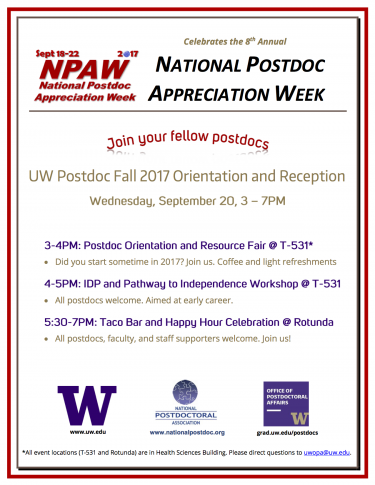
We will be celebrating you on September 20, 5:30-7pm in the Health Sciences Building Rotunda.  If you are a postdoc – or a postdoc supporter – join us for tacos and beverages.  The OPA will be hosting an orientation with key campus resources that same day 3-4pm and a workshop on planning your pathway to independence aimed at early stage postdocs 4-5pm.  Both of those sessions are in Health Sciences T-531.

Join us, and thank a postdoc!

2017NPAW_Flyer_Draft_ZB_v2.0

Translating Your Postdoc Experience into Practice

An academic journey is an interesting thing. After focusing on developing specialized knowledge in a field during your PhD and then digging deeper during your postdoc, it is understandable to wonder how you might use your specific expertise in different settings – whether inside or outside of academia.

A recent panel of Ph.D.s working in industry highlighted the importance of translating your doctoral and postdoc experience into broader terms. Taking an inventory of your skills, capabilities, and strengths can help you gain confidence as you begin to imagine you do have something remarkable to offer to a future employer or to leverage for success in your career.

Skills learned during graduate school and a postdoc fellowship have set you up to be a competitive applicant for most industry and start up jobs, in addition to the traditional academic track. By the completion of your training, you are highly intelligent, with an ability to learn and teach yourself “what you don’t know.” You are adept at gathering all the available information and making a good decision regarding what it means and what’s next. You have developed great analytical and logic-minded skills, which you can apply to move an issue, experiment or conversation forward. All it takes is stepping back, and reframing your experiences for a different audience.

Need some ideas about how your graduate and postdoc experiences have prepared you for a rewarding career inside or outside of academia? Check out this list from Peter Fiske’s keynote at the National Postdoc Association meeting 2017 (#NPA2017) to get you started:

  1. Ability to function in a variety of environments and roles
  2. Teaching skills; conceptualizing, explaining
  3. Counseling, interview skills
  4. Public speaking experience
  5. Ability to support a position/viewpoint with argumentation and logic
  6. Ability to conceive and design complex studies and projects
  7. Ability to implement and manage all phases of complex research projects and to follow them through to completion
  8. Knowledge of the scientific method to organize and test ideas
  9. Ability to organize and analyze data, to understand statistics and to generalize from data
  10. Ability to combine, integrate information from disparate sources
  11. Ability to evaluate critically
  12. Ability to investigate, using many different research methodologies
  13. Ability to problem-solve
  14. Ability to do advocacy work
  15. Ability to acknowledge many differing views of reality
  16. Ability to suspend judgment, to work with ambiguity
  17. Ability to make the best use of informed hunches

As you develop your own inventory, keep in mind that similar skills or capacities may be called different things in different sectors or fields. Do your research when you are targeting a job prospect and develop tailored versions of your CV or resume and cover letters to reflect the field specific terms.  You are prepared – it just takes a little translation to help others see it easily. We invite you to budget an hour or so a week to explore the references below for more tools and ideas.

When Is It Time to Move On?

A postdoc experience is often a leap of faith.  You might make decisions about what’s next for you after your doctoral program based on need, opportunity, ambition, passion, interest, or a combination of these factors.  Once you land a postdoc position, you will learn different things about yourself, and certainly you will also learn things about your research group that were not always clear through the interview process.

With this newsletter, we pose the question – when is it time to move on? There are numerous factors to consider, but the main thing to know is: it is healthy to ask this question, regardless of your current experience (whether 6 months or 6 years into your postdoc).

Is It Time to Change Groups?

  • Are you getting the opportunities for growth and experience that are important for your next career steps? It is not uncommon for a PI to hire a postdoc because of a skillset they bring to the group.  This is a good thing; but, if you are simply reproducing skills and experiences from your graduate research, you are not growing. You are just working.  A postdoc should be both – work and professional growth.
  • Are you in a mentoring or work environment where you can flourish? Postdocs have diverse needs when it comes to mentoring and work environments.  Learn more about your own needs and seek an environment, a mentor, and a research group that provides the experience you need to become your best.
  • What about letters of recommendation? If you truly have a difficult relationship with a PI, you will likely be concerned about the kind of letter of recommendation they will provide. This is among the reasons we often advocate for building a mentoring team, or a deeper bench of supervisors and researchers who can speak for you. Develop your own succinct, dispassionate narrative of what happened with a given faculty advisor if the relationship has truly broken down and you feel you cannot trust a letter from them. You can think about core elements that are useful to share, such as: I wasn’t getting enough independence in this particular lab group and I need to grow further; we had differences of opinion regarding best directions for the work; I learned a considerable amount but we never connected and it made it difficult to sustain the working relationship… You can make it a positive story – one that emphasizes what you are seeking more than what you are not getting. Regardless of your feelings, it doesn’t look good to future employers if you talk badly about your former supervisor.

Is it Time to Leave Postdoc-ing Behind Altogether?

  • Postdoc experiences are great for building your professional network, gaining more skills and experience, and also doing important self-reflection regarding what kind of career is really going to be meaningful for you.
  • When you’ve garnered enough skills and experience to be competitive, move on! Because of imposter syndrome, some of us may never feel truly ready.  Or myths may circulate about what it takes to be competitive in the job market.  Do your own research on what your field needs, and get feedback from several people about your track record. Hiring committees are comprised of many people and it can help to get diverse perspectives about your strengths and where your gaps may be.
  • Or, after more time in an academic research setting, you may now have enough information to know this isn’t the right trajectory for you.  Maybe for what you want to do next, you don’t need more advanced research training, but instead need to cultivate other skills or experiences. A variety of self-assessment tools can help you identify where your particular interests and skill sets are pointing you, and you may be surprised by the answers.

Whatever your situation, handling yourself professionally through the transitions will go a long way. Asking yourself – am I in the right place, am I getting what I need – is a lifelong practice that will serve you well in finding the best fit in work environment, supervision, and portfolio. And taking a proactive approach will help assure you get what you need. You never know until you ask!  If you need help thinking these issues through, or practicing how a conversation could go with your faculty supervisor, please always feel free to sign up for an office hour or make an appointment with the OPA senior faculty advisors.

Additional Resources:

Writing in Graduate School: Making Sense of Feedback

Core Programs welcomes guest writers to our newsletters – UW students, staff, and faculty.  Since it is the time of year where many of you are working hard on your writing, we invited Dr. Karen Rosenberg, UW alum and director of the UW Bothell Writing and Communication Center, to share some guidance with you.  

Getting feedback on our writing is a key part of graduate school (and, for many of us, life well beyond).  Sometimes that feedback is exactly what we need: it stretches our thinking; it confirms that the path we’re bushwhacking is gorgeous and useful; and it sharpens our tools as we continue the journey.  When we get this feedback, we know how to course correct and how to forge our way ahead.  Thank your professors and study what works about their feedback – hopefully we can use our intellect and spirit to support others down the line.

Sometimes the feedback on our writing isn’t great, but it isn’t terrible either.  It doesn’t rock our world with its insights, but we’ve been muddling along all right for a while now and the feedback serves as a green light to keep going.

But sometimes–whether intentional or not–the feedback hurts. It takes the wind out of our sails. It makes us doubt ourselves.  In one form or another, this has happened to many of us who have gone through graduate school (that is, jumped through all of the hoops we have jumped through to be in our current predicament of getting painful feedback on our writing).  So we might as well talk about it.

First, remember that we are getting feedback on one piece of writing, not on us as writers (and certainly not as whole, beautiful, complex people).  This sounds so utterly obvious, yet it bears a reminder every now and again.  We are not our writing.

Second, in the UW Bothell Writing and Communication Center where I work, we repeat the mantra: writing is never done, it’s just due.  So once we have tended to the sting of the fraught feedback, we can see if we can scavenge any useful bits from it, bits that enable us to revise our work…literally to see it again.

Before we get there, it helps to tend to the sting.  I don’t know what it feels like for you (and often I haven’t known what is has felt like for me, because when I was in graduate school I sought to distance myself from my feelings in a misguided effort to become more ‘academic’).  But during my 8 years directing the Writing and Communication Center, I’ve spent time thinking about what helps and hurts in responding to others’ writing.  Here are some tips to tend to the sting and then use the feedback to move forward:

  1. Read all of the feedback.
  2. Identify what you’re feeling. Shame? Anger? Despair? Nothing?  You don’t have to do anything with these feelings except acknowledge them and, if you can, sit with them.  Over time, this can help us receive the feedback in a less personal way.
  3. Step away for a while. Get some distance.
  4. Find your people. Seek out friends, family, and colleagues who can help you get in touch with your voice, your gifts, and your most vital reasons for being in grad school.
  5. Use your resources.  Schedule a writing tutor appointment at the Bothell, Tacoma, or Seattle campus.  And check out these online writing resources curated by the UWB Writing and Communication Center, UWT Teaching and Learning Center, and UWS Odegaard Writing and Research Center.
  6. Return to the feedback.  What’s useful about it?  What productive questions does it open up? Make a list of questions to discuss with your professor.
  7. Reject feedback that questions your right to be in academia.  For example, Latinx student Tiffany Martinez writes about a professor who circled the word “hence” on her paper with the comment “this is not your word.”  She rejects the feedback, describes the sting, and doesn’t let it derail her from academic path.
  8. Talk to your professor and make sure you have a clear sense of your next steps – ones that feels authentic to your voice and your goals for being in graduate school.


Many thanks and gratitude to Dr. Karen Rosenberg for writing this edition of the Core Programs graduate student newsletter.