Archives: Advice Posts - Page 18 - UW Graduate School Skip to content

Getting Unstuck, Moving Forward

“Success is not final, failure is not fatal: it is the courage to continue that counts.”
– Winston Churchill

We know what you’re thinking: why are you already giving me tips on how to move forward from feeling stuck so early in the quarter?  Well, we thought we’d offer you some preventative tips to help you pull through, no matter where you’re at this quarter or what year you are in your degree program.  Besides, everyone gets stuck in life, and graduate school is no exception by any means. There are several factors that can contribute to feeling stuck from getting our work done.  We’ve put together a short list of these, including ways you can move forward.  So let’s begin:

Relieving the pressure.  Looming deadlines for school and work.  Family, community, and financial responsibilities.  Preparing for job searches, interviews, and possible relocations—near or far.  Those pressures can make us feel overwhelmingly stuck.  One way to relieve this weight is to re-focus your attention on what you need right now:  Do you need to slow down and take a few deep breaths (repeat every few hours)?  After that deep breath or two, and in a calmer state of mind, identify a single step you can take for one of your tasks that would help you feel you have accomplished something today.  Each task is just made up of a whole series of steps.  We have to start somewhere, and it often helps relieve the pressure to just take that one step.

Finding value in yourself (despite imperfections). We all struggle and have shortcomings. Indeed, in a job interview a common question is, “Tell me about your weaknesses!”  Being honest about your own limitations – not critical, just descriptive – can sometimes give you the awareness you need to move ahead again.  More often than not, we need a trusted conversation partner to help us see this perspective.  Reach out for support from peers, departmental staff or advisors, loved ones, or campus resources (whomever you feel most comfortable with).

Facing the fear of failure.  Academia can perpetuate the myth that we must be highly productive, all of the time.  And if we’re not, we must be failures.  Not only is this unrealistic and unattainable, this kind of culture obscures actual strategies for how to do our best work—and it can keep us from trying in the first place.  So how can we best manage this?  First, it’s helpful to think of failure in terms of progress over time—so you can grow into being that better professional, practitioner, or scholar.  It’s a process, not an end result.  You try, you learn, and you move forward—all the while validating and/or rewarding yourself each step of the way.  No matter how big or small the milestone.  It’s also vital that you build a support system of people who’ve got your back and will recognize your achievements along with you.

Remembering your purpose.  Feeling stuck can make you forget why you are in graduate or professional school in the first place.  It can also keep you in a false feedback loop that makes you believe that you are unsuccessful or unworthy of achievement.  Whenever you feel this way, remember that you are working hard towards your degree for many amazing reasons and focus on those—whether it’s to making a contribution to a field of knowledge, impacting policy that improves lives, getting a job that you love and that helps you provide for your families.  Remembering your end goals helps us focus on what really counts.

Warmly,

Jaye Sablan, Kelly Edwards, Ziyan Bai
Core Programs Team
By Veterans, For Veterans

Graduate student and veteran Lindsay Zike wanted to help others make the transition from soldier to student. The Office of Student Veteran Life, recently established with her help, is doing just that.

Mental Health and Wellness

MH&W

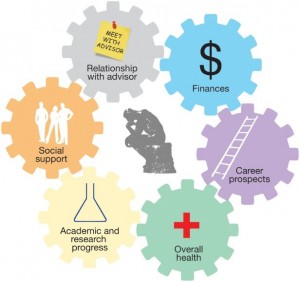
Towards Sustaining a Culture of Mental Health and Wellness for Trainees in the Biosciences, written by Jessica W Tsai and Fanuel Muindi, discussed the importance of mental health of postdocs in benefiting the scientific community at large. Studies are limited, but we can see we clearly have work to do. According to one study, only 13% of postdocs are “flourishing” and we know that a postdoc position doesn’t lend itself to regular exercise, healthy diets, or good stress relieving practices.  Lack of sleep and high levels of stress actually impede performance.  Bottom line: our work will get better if we take care of ourselves!

As the figure above shows, there are many factors that contribute to well-being. Do your own self-assessment to see where you have areas of strength and where you may need to seek more support. If you are experiencing significant stress, anxiety, or depression, there are offices that can help. You may be eligible for accommodations – even on a temporary basis – and it can be worth discussing with the Disability Services Office.

The UW Mindfulness Project aims to increase holistic wellness, self-inquiry, grounded leadership and compassion within UW community and beyond. Check out their Facebook Page.

Health & Wellness provides support, advocacy, consultation and education to the UW campus community. Check out their website for more information.

For additional resources and suggestions on many dimensions of self-care, visit the UC Berkeley “Be Well” page.


Originally posted on March 24, 2016.

Hours and Hours of Office Hours

I am a TA for a graduate level class this quarter, and my professor is asking me to hold 4 hours of Office Hours. I feel this is too much. I had TA’d the same class last quarter, and I had five hours of Office Hours, way more than any other grad class in my department. It was incredibly stressful, and I grew to hate the work because of the long hours. I was hoping that this quarter I can have office hours similar what others in my department hold. How do I tell my professor? I want a good recommendation letter from him eventually and don’t want to anger him, but there simply doesn’t seem to be an indirect way to tell him what I want to say. —Anonymous

This is exactly the type of situation to take to the Office of the Ombud. They specialize in handling conflicts with others at UW and will help you approach your professor with your concerns. Additionally, you can consult the Center for Teaching and Learning for tips on how to manage office hours and handle the stress that comes with teaching.

Ask the Grad School Guide is an advice column for all y’all graduate and professional students. Real questions from real students, answered by real people. If the guide doesn’t know the answer, the guide will seek out experts all across campus to address the issue. (Please note: The guide is not a medical doctor, therapist, lawyer or academic advisor, and all advice offered here is for informational purposes only.) Submit a question for the column →

Break?! Making Time For Yourself

We know that depending on your graduate or professional degree program, “spring break” looks very different from your days as an undergraduate–at least in terms of the work. You may be doing fieldwork locally or globally, applying for funding, preparing for job searches or qualifying exams, writing your thesis or dissertation, or working at a practicum site.

All this is true, but this doesn’t mean you can’t appreciate all that is you. In fact, given the tips we share below, you don’t have to wait for an official break to honor–and take care–of yourself. You can make that happen any time of the year.

Press pause. We move at break-neck speeds, going from one task to the next, barely allowing ourselves to just be. So go on, give yourself permission to slow down and breathe deeply, take several deep breaths–for however long it takes. The world will not end, we swear.

Appreciate yourself. Isn’t it funny how it can be easier to treat our friends and loved ones better than we treat ourselves, especially when they’ve been working hard or going through a rough time? So what’s stopping you from treating yourself to a nice meal or new pair of shoes? Why not buy a book you actually want to read? Why can’t you go on a staycation? You know what? There’s absolutely no reason why you can’t, so go on and do it! Do more than one. It’s not selfish. It’s self-love.

Laugh at yourself. You all work incredibly hard in your respective fields, and you are also awesomely, brilliantly human. Both are true. We all can’t help but be imperfect, so we might as well laugh at those embarrassing moments where we aren’t always our best selves.

Let go of guilt. Give yourself permission to not feel awful for taking care of yourself. By taking some time out for you, you’ll be able to return to longer term projects feeling energized. Also, taking time for yourself benefits everyone in your circle, because you’re all the more happier for it!

Warmly,

Jaye Sablan, Kelly Edwards, Ziyan Bai
Core Programs Team

Crushed

How do you cope with a breakup of a long term relationship while job searching, moving and taking care of your family? It seems impossible. I feel crushed. I’ve used up my free counseling services due to a family crises earlier in my graduate experience. I don’t know what to do or where to go. My whole world is altered right before I was supposed to go out into the world determined for new experiences and greatness. I thought that I would have them to share that with me. But now it’s over. I’m lost. —I once was a bot

My heart goes out to you. The only responsible thing I can do is refer you to professional counseling. I do have a kernel of good news for you, though. You are still eligible for free counseling through the UW Counseling Center. There seems to be a lot of misinformation out there about counseling sessions for students. A representative from the Counseling Center confirmed that there used to be a cap on sessions in the past, but that is no longer the case. So you can absolutely go back and receive help for your current situation. Best best best of luck to you!

Ask the Grad School Guide is an advice column for all y’all graduate and professional students. Real questions from real students, answered by real people. If the guide doesn’t know the answer, the guide will seek out experts all across campus to address the issue. (Please note: The guide is not a medical doctor, therapist, lawyer or academic advisor, and all advice offered here is for informational purposes only.) Submit a question for the column →

Building and Maintaining Momentum

It’s nearing the end of winter quarter, and we know it can be difficult to keep your spirits and energy up as you work to fulfill on and off campus responsibilities.  We are right there with you.  Here are five tips to help keep you going:

Set achievable goals.  Rather than promising yourself that you’re going to spend 5 full hours in one sitting to work on a paper, approach time management realistically.  Try writing in 30 minute chunks.  Take a short break and pick it right back up.  This approach can be a great stress reliever, because you can make progress one step at a time.

Set boundaries.  Set healthy boundaries on campus, at work, and at home–and if you haven’t done so, now is a good time as any to practice. Take stock of what you have to get done in the next two weeks.  You can hold off on any tasks and responsibilities that can realistically wait for the next few weeks or month. Boundary setting helps you realize that you do have control over your schedule.

Meet with your support system.  Have you checked in with people who’ve got your back?  This may include faculty, graduate program advisors, loved ones, student peers, or work colleagues. More than one person in your support system is better. Check in with faculty via e-mail or in person and focus on one or two goals you have for the rest of the quarter.  Meet with a peer at the library or a coffee shop to write and go over ideas and drafts.  Connecting with loved ones and community is important and can remind you that you are more than just a graduate student.  Call, text, skype, share a meal, and/or make plans to spend time together.

Keep yourself nourished.  What keeps you going and energized?  Do you need a glass of water? How about a snack or meal?  A short nap or a good night’s sleep?  Is there a song, movie, hobby, or activity that restores your motivation?  Is there something you are looking forward to during Spring Break? Post an image or word in your work space or apartment that reminds of you of what you are looking forward to–to keep yourself moving toward that finish line. And it’s always helpful to reflect back on why you’re here in graduate school in the first place (insert personal, intellectual, and professional goals here).

Have faith in yourself.  You do have what it takes.  Really, you do!  You can do your best now and it will be enough.

Warmly,

Jaye Sablan, Kelly Edwards, Ziyan Bai
Core Programs Team

Gratuitous to Grade Grammar?

I’m a TA for a graduate-level course, and many of the students are not native English speakers. I am grading assignments with significant grammatical errors: incorrect tenses, wrong plurals, missing articles, etc. I’m struggling with the tension between not unfairly penalizing students, since English isn’t their first language, but also holding them to a high standard for academic writing, given that they are getting a graduate degree. How have other TAs or instructors handled this? —Grammar Nerd

(This week’s answer is courtesy of Katie Malcolm, Instructional Consultant, Center for Teaching and Learning.)

Thank you for asking—this is a question we hear often in the Center for Teaching and Learning. Although we recommend that TAs check with their supervisors to see if their departments have specific policies about this, the TAs we have worked with over the years and our own teaching experiences have given us some helpful perspectives. When thinking about how to fairly assess my own international and multilingual students’ writing, I ask myself two questions: 1) What are my goals for the assignment? What do I need to prioritize? and 2) How can I communicate these goals to my students in ways that will help them succeed?

1. First, I think about what is important to prioritize for my students in each assignment, given my realistic learning outcomes for a 10-week course. What is the primary goal I want students to achieve through each writing assignment?

In my own assignments, my first priority is for students to develop and sustain a logical argument in conversation with relevant research. If students’ errors leave me unable to understand their argument, I can’t assess it meaningfully, and—whether English is their first, second, or fifth language—I will ask them to edit and revise the assignment in order to receive credit.

Because my primary goal is not for students to write as though English were their first language, if incorrect verb tenses or missing articles do not detract from my ability to understand a student’s point, I tend to overlook or “read through” them, or point out a couple of occurrences in the margins and then make a note of these patterns in my end comments. (Showing students the patterns of their errors helps them learn how to avoid these kinds of errors in the future). Just as students need time and practice to develop fluency in their pronunciation and speaking, they also need time to develop fluency in academic, discipline-specific English writing.

2. Once I have articulated my expectations for students’ writing, I clearly communicate these expectations to students in several ways:

  • At the same time that I introduce an assignment, I share the assignment grading criteria, usually in the form of a rubric. When writing style is an important aspect of the assignment (as it often is), I make sure that it is part of the grading criteria and weighted appropriately.

  • I assign multiple drafts so that students know that I do not want them to start a paper the night before it’s due (often a major culprit of unedited papers). I’ll ask students to bring an early draft to class for peer review, or to bring a draft to my office hours, and/or to visit the Odegaard Writing and Resource Center (OWRC) to get feedback on their writing early in the process.

  • I share writing resources with my students, including information about OWRC, which has drop-in hours for graduate student writers in the Allen Library. There are also a number of great online resources on proofreading that may be helpful to students, such as the Purdue OWL’s “Finding common errors” page and their pages dedicated to multilingual writers. UNC also has some helpful editing resources.

Again, thanks for asking this great question — if you would like to talk more about this or other aspects of your teaching, please don’t hesitate to contact us at thectl@uw.edu.

Ask the Grad School Guide is an advice column for all y’all graduate and professional students. Real questions from real students, answered by real people. If the guide doesn’t know the answer, the guide will seek out experts all across campus to address the issue. (Please note: The guide is not a medical doctor, therapist, lawyer or academic advisor, and all advice offered here is for informational purposes only.) Submit a question for the column →