Built to play
Mia Hoffman receives this year’s Graduate School Medal Award for her work to reimagine assistive technology for young children
The project began with a simple question: How could a two-year-old with cerebral palsy play alongside her older sibling?
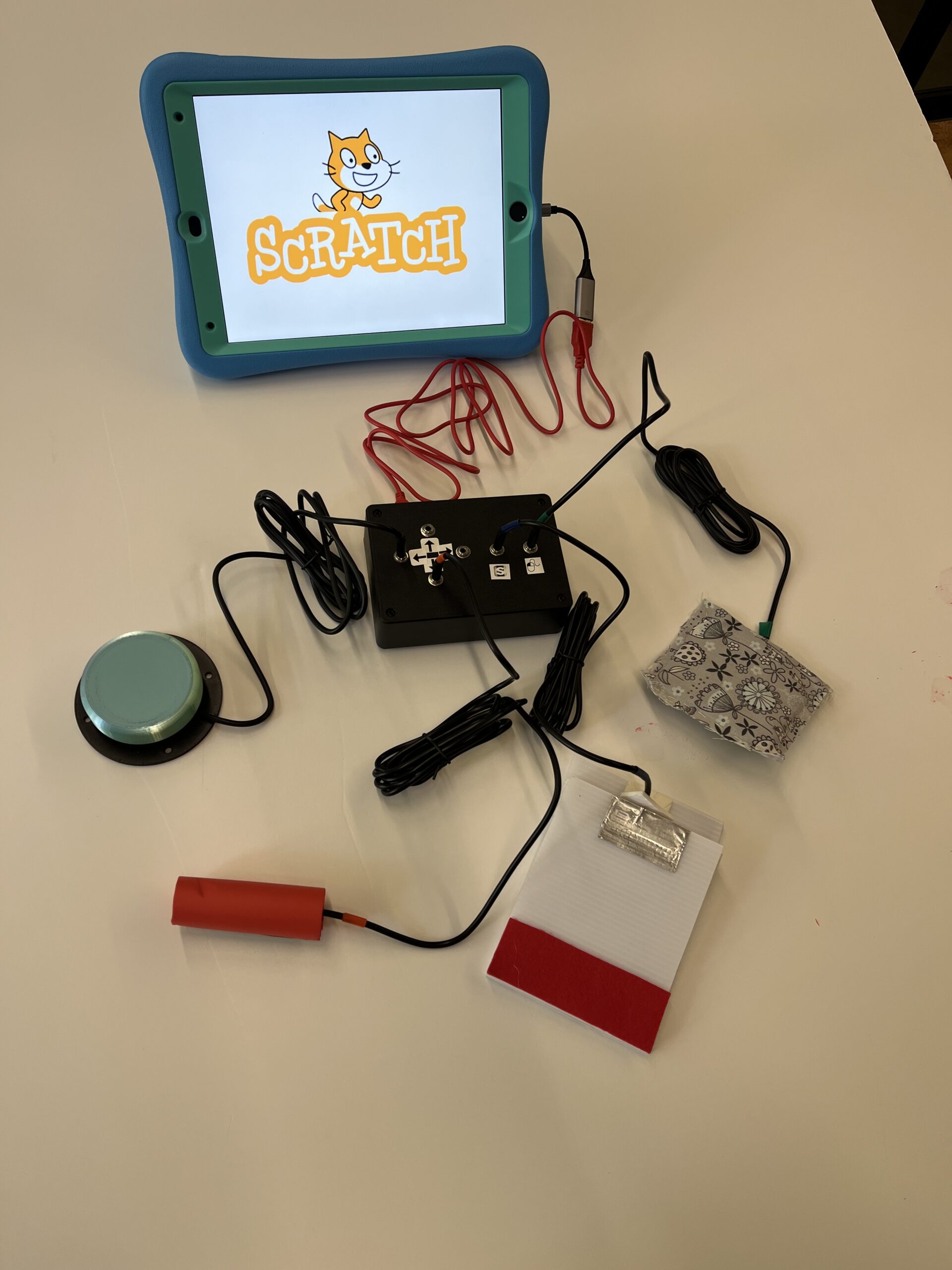
That question ultimately led University of Washington Mechanical Engineering Ph.D. candidate Mia Hoffman to develop the “Switch Kit,” an adaptable play and communication system that is helping children with motor disabilities engage more fully in play. Hoffman is advised by Dr. Kat Steele in mechanical engineering and Dr. Heather Feldner in rehabilitation medicine.
For that work—and for a career defined by community-engaged research—Hoffman has been named this year’s Graduate School Medal recipient. The award recognizes doctoral candidates whose academic expertise and social awareness are integrated in ways that demonstrate active civic engagement and a capacity to promote political, cultural and social change.
As a child, Mia Hoffman spent time at Nationwide Children’s Hospital in Columbus, Ohio and later landed her first research job there, experiences that cemented her desire to work at the intersection of research and pediatric care. Her work is grounded in the belief that progress emerges from a two-way dialogue between researchers and the communities impacted by their work.
Before arriving at UW, Hoffman studied Mechanical Engineering at the University of Notre Dame, where she helped launch a student organization that connected engineering students with community partners. The group designed and 3D-printed prosthetics and adaptive devices for children with limb differences, an experience that reinforced her commitment to pediatric research.
"I helped get the club off the ground and by working with the community, I knew I wanted to work in Pediatrics,"
Using inexpensive materials and customizable switches, the system allows children with disabilities to engage with digital play environments in developmentally meaningful ways. Hoffman has open-sourced these designs, partnered with community organizations to distribute them and helped make adapted toys available to families throughout Washington State through her leadership in HuskyADAPT, a student organization that is dedicated to supporting accessible design and inclusive play technology.
Families suggested ideas ranging from wearable glove switches that activated when children clapped to customized interfaces based on favorite characters or songs. Speech-language pathologists contributed ideas for communication tools. Clinicians adapted games to fit specific developmental goals.
The result became more than a toolkit—it became a framework for co-design with families, clinicians and engineers working together to create solutions that could evolve alongside each child’s needs.
“We wanted families to see these designs and think bigger. Here’s a starting point, but you can make it your own.”
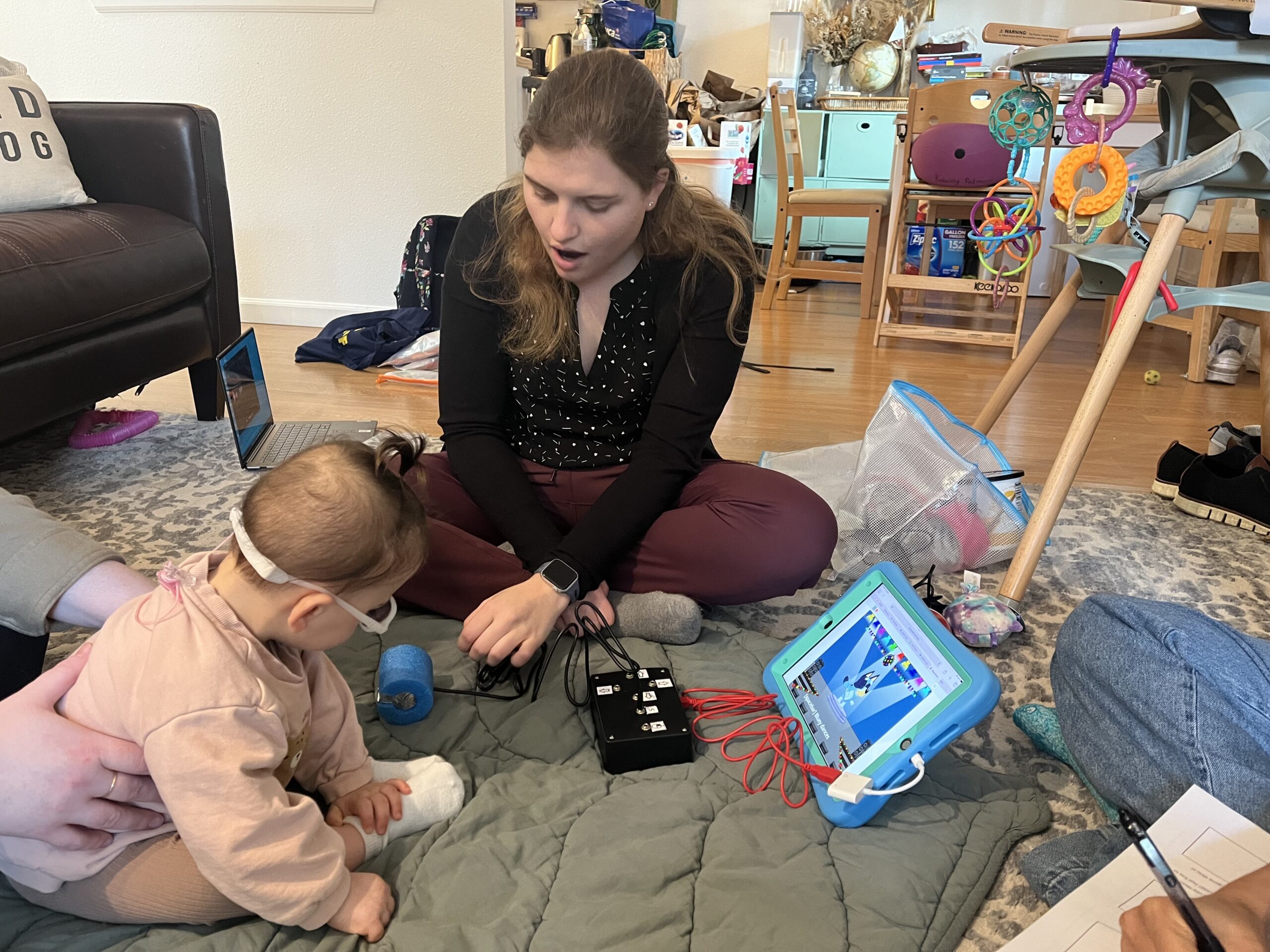
Hoffman using the Switch Kit with a child.
That philosophy extends beyond the Switch Kit. Hoffman challenges a common assumption in engineering: that technologies designed for adults can simply be scaled down for children.
“There is a phrase in the field: shrink it and pink it,” she said. “You take something designed for adults, make it smaller, maybe make it colorful, and call it pediatric. But kids aren’t small adults.”
Instead, she advocates for designing technologies from the ground up with children’s developmental needs, play behaviors, and growth patterns in mind—especially for children ages zero to five, a period she describes as critical for development.
In addition to the Graduate School Medal, Hoffman has been recognized through the Husky 100.
Now, as Hoffman prepares to leave Seattle and begin a Presidential Postdoctoral Fellowship at The Ohio State University, she is already planning the next chapter.
Looking ahead, Hoffman hopes to establish the MAP Lab—Mobility, Accessibility and Play Lab—a research space dedicated to helping children participate more fully in the activities that shape childhood. Her upcoming research will investigate an emerging area with little existing evidence: mini manual wheelchairs for young children. While powered mobility devices have received growing research attention, Hoffman hopes to better understand how younger children use manual mobility devices and what benefits they may provide.
For Hoffman, however, technology itself has never been the end goal.
“We’re not out here saving the world,” says Hoffman. “Technology is just a tool. At the end of the day, the goal is to make it a little easier to play or a little easier to participate.”
By: Tatiana Rodriguez, UW Graduate School
Published on June 15, 2026