In what ways do Black disabled preschool-aged children assert agency in relation to and beyond normative developmental expectations?
How can clinical gait analysis for children with cerebral palsy be improved?
These are questions which motivate the newest Gatzert Child Welfare Fellows. The Gatzert Child Welfare Fellowship is a one-quarter fellowship awarded to UW Ph.D. candidates writing dissertations that contribute to the lives of children with disabilities. Congratulations to 2026 Fellow Malcom King and Mackenzie Pitts!
Malcom King
Education: Curriculum & Instruction
Dissertation: “Beyond Development: Black Disabled Preschool Children’s Agency Across Classroom and Community Spaces“
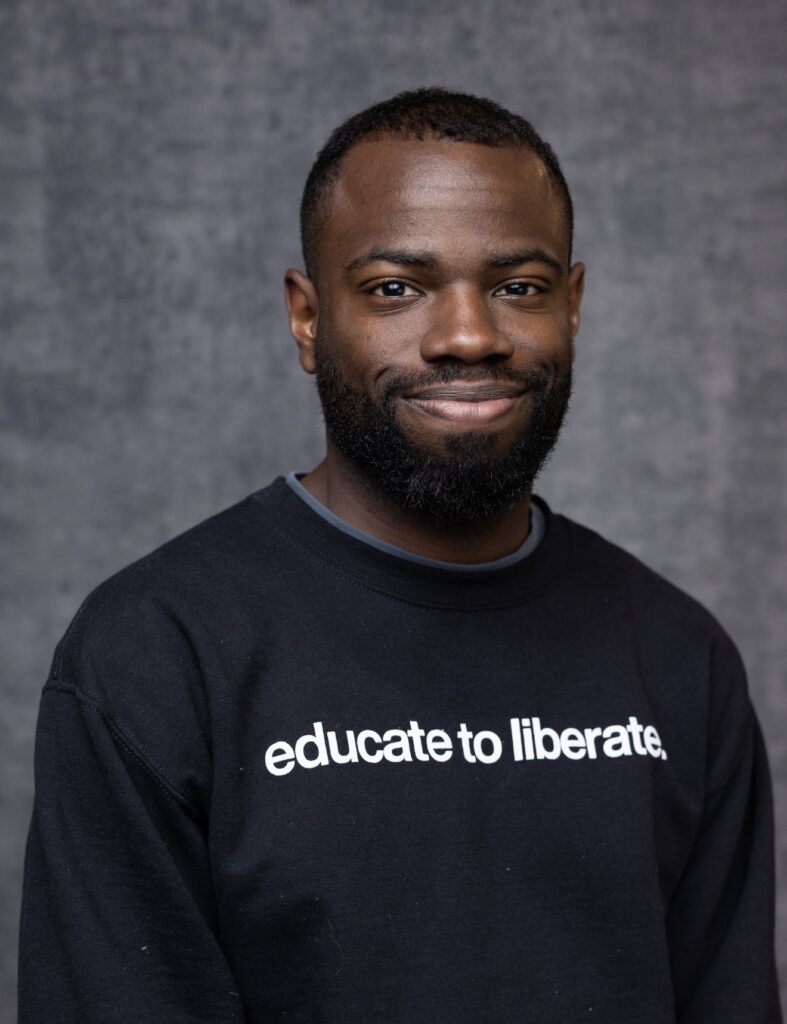
Malcom King is a doctoral candidate in the UW College of Education, advised by Dr. Maggie Beneke, who is committed to creating research and design practices that nurture possibility, connection, and community transformation, particularly as it relates to the experience of Black children navigating racist and ableist contexts. His work is rooted in cultivating spaces where children and families can bring their full selves, their creativity, and their ways of knowing into collective processes that imagine and live into more liberatory futures.
Malcom is passionate about how Black disabled preschool-aged children make meaning of racist and ableist worlds, and how those processes and expressions shape their relationships, choices, and desires. He is drawn to the everyday moments where children express agency, care, and curiosity, and he works to join the spaces in both community and schools that honor those expressions. In his research, and his everyday life Malcom seeks to refuse systems of oppression and build the liberatory worlds alongside children and their communities.
Outside of work, Malcom finds joy in his faith, in swimming, painting, reading and spending time in community with loved ones.
Mackenzie Pitts
Mechanical Engineering
Dissertation: “Personalizing Clinical Gait Assessments For Children With Cerebral Palsy”

Mackenzie Pitts is a PhD candidate in the UW Mechanical Engineering department, advised by Dr. Kat Steele, where her research focuses on optimizing clinical gait analysis for children with cerebral palsy. She develops interpretable, data-driven techniques to better evaluate gait patterns, with the goal of improving how clinicians understand and personalize treatment. She earned her BS in Mechanical Engineering from Auburn University, and her graduate career has allowed her to combine her passion for understanding movement in complex systems with a human-centered perspective.
During her time at UW, she has deepened her commitment to learning and equitable access to education. In Mechanical Engineering, she has served as a Teaching Assistant for multiple dynamics courses, where she explains concepts in diverse ways to support different learning styles. Additionally, she has worked with A Vision for Electronic Literacy and Access student organization to encourage underrepresented students in the greater Seattle area to pursue STEM careers, as well as mentored an undergraduate student on a research project related to her work. These experiences have shaped how she thinks about education not just as instruction, but as translating complex ideas to diverse audiences that value the information shared.
Mackenzie carries this same perspective into her research where she views her work as both technical development and science communication. She aims to translate ideas between engineering, data science, and clinical practice so that tools are rigorous and meaningful. By developing interpretable methods, she seeks to support clinical decision-making to improve individualized care for children with cerebral palsy and other conditions that affect gait. She is honored to receive the Gatzert Child Welfare Fellowship, which will allow her to dedicate time to ensuring clear communication of her work to diverse audiences. After completing her PhD, she hopes to continue developing data-driven, patient-centered tools that bridge engineering and clinical practice.