Support – Page 2 – UW Graduate School Skip to content

When Things Don’t Go As Planned… Now What?

As we’ve noted in past newsletters, this is the time of year where it seems everyone around you is hitting milestones, getting summer internships or jobs, being awarded fellowships, or graduating.  What happens when you find yourself in the midst of setbacks or what feel like roadblocks to your progress?

Maybe you’ve been applying for jobs and haven’t received calls for interviews.  Maybe all those fellowship applications are going unanswered.  Perhaps your committee or advisor decided to postpone a major exam until the fall quarter, throwing off the timeline of goals you planned for.  What now?

We consulted a few sources for advice, including the UW Resilience Lab. First, it’s important to acknowledge and sit with the emotion you’re experiencing (perhaps shame, disappointment, frustration, anger, or all of the above).  Recognizing your feelings is an important step for moving forward, otherwise it can be difficult to see through the emotion and be creative about next steps.

Second, talk with trusted individuals about what you are facing.  It can feel like everyone around you is successful, but you may be surprised at just how many setbacks and failures are experienced by all of us (including advisors and mentors). Talking with others can help validate your feelings and also help you see additional perspectives on what’s happening–as well as generate more creative ideas about what you can do to adjust, adapt, and move forward.

Business consultant and author Chris Winfield offers these tips to address what to do in the face of setbacks, highlighting how setbacks can be learning and growth opportunities:

– Give yourself time. Lifehacker recommends 24 hours just to let it out.
– Avoid making any big decisions, if you feel panicked or overwhelmed.
– Make peace with your failures.
– Cut yourself some slack (but don’t let go of the rope).
– Regain your control.

For more on these tips, see Winfield’s blog post.

Whether you are sailing through the end of the quarter or not sure what’s next for you, we stand with you.

Best Regards,

Core Programs Team
Additional Resources

From an Overworked TA

The class I am a TA for requires 12 hours of student interaction and about half a day of preparing materials. Every week. This is way more than the 20 hours/week that I am paid to do. The instructor knows this and had originally requested twice as many TAs as we have, but the department, being broke, only assigned two of us for this awful job. This particular class is known to be this way, as I have learned from talking to past sufferers. I have been TA-ing for two years now and have noticed a wild disparity in the workload for different classes. My question is: how is this fair? The department pays everyone the same amount, still how is it that some TAs get away with just 4 hours of work while others have to do upwards of 20? Since this is an issue of the department, I don’t know how to proceed. The officials in the department get very defensive when asked this. I don’t want to risk not being considered for future TA positions and am therefore not going to pursue the topic with them, but isn’t this just exploitation of us students by those in power? If the department has no money, they should figure out a better way to do this than exploit two students every 
quarter (yes, this class is taught every quarter). I am at a loss here and am losing my sanity not finding time to do anything else that actually matters for my Ph.D. Please help. –Anonymous 

This week’s answer is provided after consultation from the Labor Relation’s Office

Yikes. I’m sorry this TA-ship has been such a negative experience for you. Fortunately, you have resources at your disposal to help you resolve some of these issues.

You’ve said you do not wish to pursue these issues with your department. But you should know all academic staff employees are covered under a collective bargaining agreement by UAW Local Union 4121. If you do want to file a grievance against your department, the Union will help you do that. A Union representative urges Academic Student Employees to remember that addressing workplace concerns is time-sensitive under the Union contract.

Another resource available to you is the Office of the Ombud, which provides a space for members of the UW community to voice their concerns and develop plans for addressing difficult situations. The Ombud is easily accessible, with offices on all three campuses. Students contact the Ombud to discuss a range of issues including TA appointments. They are your go-to for addressing problems with the department’s culture. They’ll advise you on your situation without starting a formal complaint or grievance, and they won’t contact your department about the matter unless you ask them to do so.

Best of luck!

Ask the Grad School Guide is an advice column for all y’all graduate and professional students. Real questions from real students, answered by real people. If the guide doesn’t know the answer, the guide will seek out experts all across campus to address the issue. (Please note: The guide is not a medical doctor, therapist, lawyer or academic advisor, and all advice offered here is for informational purposes only.) Submit a question for the column →

Strengthening Yourself for the Last Leg of the Quarter

We at Core Programs recognize and respect all the hard work you’ve been doing as graduate students during this winter.  We know that Winter quarter can be especially challenging given the weather, the darkness, and the usual stressors of navigating a graduate program. The good news is that the light is returning and the quarter is coming to a close!  For this final push, we offer a few strategies. Maybe one or more will serve you:

Saying “Not Right Now”.  We know that many of you are balancing personal and family time, school, and work responsibilities, and we encourage you to take a pragmatic look at your schedule for the next few weeks.  What can you absolutely hold off on doing for now (that you can then return to later)?  What do you absolutely need to make room for?  Whom do you need to say no to?  With the rhythm of the quarter system, there are time intensive moments where you have to keep your head down and focus. There’s a lot to do, but it will pass by quickly.  Then you can once again say “yes” to other things after the quarter is done.

Schedule your needs. Put the most important things you need to accomplish in your calendar, including self-care practices. When it comes to working on those final seminar papers, consider setting aside 30-60 minutes a day to work on a draft versus trying to do it all in one sitting.  Writing in smaller chunks will help you feel better knowing that you are making regular progress. Believe it or not, scheduling yourself for 30 minutes of exercise, or connecting with someone important, can make a difference in your overall productivity.  So can getting enough sleep!  While many people do gain energy from looming deadlines and big pushes of work, suffering isn’t a requirement of graduate school. We just can’t do our best work, if we are constantly in a stressed and exhausted state of mind.

Ask for help.  Now is as good a time as any to reach out for help.  Do you feel stuck on an individual project and don’t know how to move forward?  If you haven’t done so already, connect with peers in your program who are further along in their graduate work.  More often than not, they have strategies that worked for them, that you can then try out for yourself.  If you are having a hard time finding someone in your department, get a list of peer referrals from your Graduate Program Advisor or a student organization on campus that you relate to.  Or maybe you need to reach out to your professor for an extension all together—because life happens. There is no shame in this at all.  Asking for what you need is a sign of honest self-assessment and shows you are taking responsibility for yourself. But you have to act fast.  Either drop in during your professor’s office hours or send them an email with your extension request, with a reasonable deadline for when you plan to submit your work (this may have to be negotiated depending on your professor’s upcoming schedule).  If you’re communicating by e-mail, you can put “Time Sensitive Request” in the subject line and follow up with your professor as needed.

Reward yourself.   Make room in your schedule to celebrate yourself for all the work you’ve done—however small or big the milestone.  Recognizing your achievements is so important, as no one else will make time in your schedule to do so except for you.  When you have many important deadlines at the end of the quarter, consider allowing yourself a small celebration after a project is done–before you turn to the next task or project.  Plus, it really allows you to be present with your progress in graduate school.  You are doing a ton of work!  Go for a walk with a friend.  Make yourself a nice dinner.  Go dancing (and get to the venue before the cover charge).  Take a short dive into Netflix.  Schedule a game night in with friends, or 21 other affordable examples of treating yourself.

We love hearing from you!  Let us know your strategies for getting through Winter Quarter!

Best,

Kelly, Jaye, and Ziyan
Core Programs Team

Ground Yourself These Last Few Weeks of the Quarter

We see how hard you’re working.  You’re running here and there, juggling multiple responsibilities related to all aspects of who you are as a graduate or professional student.  In the midst of this spring quarter chaos, we want to offer you some tips to help ground you in these last few weeks of the quarter.

Connect with your body.  Feeling accumulated tension in your muscles?  Are you having trouble keeping your energy up?  Maybe you’ve been agitated the last few days.  These are all signs that your body is stressed.  We know this is common knowledge, but isn’t it interesting how we can easily ignore bodily feedback and try to plough through the day or week anyway?  Try taking 10-15 minutes out of your day to connect with your body (this is very possible as we can easily spend 10 minutes on social media).  Go for a brief afternoon walk on campus or outside of your home.  Sit in a quiet place such as the library, close your eyes, and take several deep breaths.  Match your caffeine intake with hydrating water (we won’t tell you to cut back on coffee, not now!) .  Keep healthy snacks on hand to make it easy to stay fueled with vitamin rich food. Connecting with your body allows you to be more mindful of your stress level and to actively respond to decrease it.

Shift from distraction to purpose.  It’s easy to get caught in a negative feedback loop of feeling bogged down, frustrated, or depressed about all the things you have to do to close out the year or complete your graduate degree.  And your feelings are totally valid and real.  Yet you are also a whole person and not just the sum of stressful experiences.  In those moments, it’s helpful to remind yourself of your purpose for earning that graduate degree.  You want to contribute to innovation in your field.  You are seeking to impact change in collaboration with your community.  You want to better support yourself and your family.  You want to make a unique contribution to knowledge and research.

Good enough is good enough.  Academia has the capacity to make us feel that we aren’t doing or achieving enough.  Yet in reality, we in Core Programs know that this is just not true.  We have the privilege of collaborating, and engaging in conversations, with a range of graduate and professional students throughout the year.  We get to hear about all the amazing things (no matter how big or small) you are involved in, projects and interests that go above and beyond your degree programs.  We also know that you have families you’re taking care of, working at one or two jobs to make ends meet, or that you are not always validated or seen on campus.  We too have projects that are not yet done, and a long list of things we want to get to.  Your work is never done–this is why the world (and your loved ones) needs you!  We’re telling you right now, you are enough.  And we see you.

Anchor yourself in community.  Make the time in your schedule to hang out with friends, colleagues, or family who care about your well-being and success.  Spend time with people whose well-being you care about.  Reach out to people who share your hobbies and interests.  Go hiking with your best friend.  Plan pizza and a movie night with peers in your cohort.  Make plans for connecting after your last deadline this quarter.  If you’re new to Seattle, consider joining a meetup group based on your interests.  Anchoring yourself in community reminds you that you are a whole person!

Warmly,

Jaye Sablan, Kelly Edwards, and Ziyan Bai
Core Programs Team

Mental Health and Wellness

MH&W

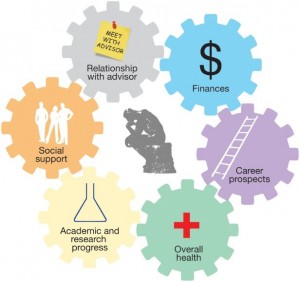
Towards Sustaining a Culture of Mental Health and Wellness for Trainees in the Biosciences, written by Jessica W Tsai and Fanuel Muindi, discussed the importance of mental health of postdocs in benefiting the scientific community at large. Studies are limited, but we can see we clearly have work to do. According to one study, only 13% of postdocs are “flourishing” and we know that a postdoc position doesn’t lend itself to regular exercise, healthy diets, or good stress relieving practices.  Lack of sleep and high levels of stress actually impede performance.  Bottom line: our work will get better if we take care of ourselves!

As the figure above shows, there are many factors that contribute to well-being. Do your own self-assessment to see where you have areas of strength and where you may need to seek more support. If you are experiencing significant stress, anxiety, or depression, there are offices that can help. You may be eligible for accommodations – even on a temporary basis – and it can be worth discussing with the Disability Services Office.

The UW Mindfulness Project aims to increase holistic wellness, self-inquiry, grounded leadership and compassion within UW community and beyond. Check out their Facebook Page.

Health & Wellness provides support, advocacy, consultation and education to the UW campus community. Check out their website for more information.

For additional resources and suggestions on many dimensions of self-care, visit the UC Berkeley “Be Well” page.


Originally posted on March 24, 2016.

Building and Maintaining Momentum

It’s nearing the end of winter quarter, and we know it can be difficult to keep your spirits and energy up as you work to fulfill on and off campus responsibilities.  We are right there with you.  Here are five tips to help keep you going:

Set achievable goals.  Rather than promising yourself that you’re going to spend 5 full hours in one sitting to work on a paper, approach time management realistically.  Try writing in 30 minute chunks.  Take a short break and pick it right back up.  This approach can be a great stress reliever, because you can make progress one step at a time.

Set boundaries.  Set healthy boundaries on campus, at work, and at home–and if you haven’t done so, now is a good time as any to practice. Take stock of what you have to get done in the next two weeks.  You can hold off on any tasks and responsibilities that can realistically wait for the next few weeks or month. Boundary setting helps you realize that you do have control over your schedule.

Meet with your support system.  Have you checked in with people who’ve got your back?  This may include faculty, graduate program advisors, loved ones, student peers, or work colleagues. More than one person in your support system is better. Check in with faculty via e-mail or in person and focus on one or two goals you have for the rest of the quarter.  Meet with a peer at the library or a coffee shop to write and go over ideas and drafts.  Connecting with loved ones and community is important and can remind you that you are more than just a graduate student.  Call, text, skype, share a meal, and/or make plans to spend time together.

Keep yourself nourished.  What keeps you going and energized?  Do you need a glass of water? How about a snack or meal?  A short nap or a good night’s sleep?  Is there a song, movie, hobby, or activity that restores your motivation?  Is there something you are looking forward to during Spring Break? Post an image or word in your work space or apartment that reminds of you of what you are looking forward to–to keep yourself moving toward that finish line. And it’s always helpful to reflect back on why you’re here in graduate school in the first place (insert personal, intellectual, and professional goals here).

Have faith in yourself.  You do have what it takes.  Really, you do!  You can do your best now and it will be enough.

Warmly,

Jaye Sablan, Kelly Edwards, Ziyan Bai
Core Programs Team

Do I Have to TA if I Have a Fellowship?

I received an NRSA predoctoral fellowship. My understanding is that the fellowship is to cover my graduate school tuition so that I can devote full-time efforts to research (as required by NIH policy). However, my department has requested that I TA in the Spring quarter (concurrently with my fellowship) to cover the tuition shortfall. Is this typical? Are there options for tuition waivers so that I may focus solely on research? Are there limits to the number or amount of tuition waivers for NRSA recipients? 

(This week’s answer is courtesy of Helene Obradovich, Director of Fellowships and Awards, Graduate School.)

The Graduate School often provides tuition waivers for students who receive prestigious, individually-awarded, nationally-competitive fellowships from external organizations that don’t cover the full cost of tuition. We want to ensure that graduate students know that they can and should apply for these prestigious awards without concern for how they will cover the cost of tuition. Examples of types of funders/awards include the Ford Foundation Pre-doctoral and Dissertation fellowships, NSF Graduate Research fellowships, ACLS fellowships, etc. NIH NRSA individual fellowships also fall into that category. Have your department contact our Fellowships & Awards office to discuss how this might work. The request for tuition coverage must come from your department.  Our staff can be reached at gradappt@uw.edu or 3-7152. Any graduate student considering applying for an award that doesn’t cover the full cost of tuition should also contact our Fellowships & Awards office before applying for confirmation on whether we can assist with tuition coverage.

Ask the Grad School Guide is an advice column for all y’all graduate and professional students. Real questions from real students, answered by real people. If the guide doesn’t know the answer, the guide will seek out experts all across campus to address the issue. (Please note: The guide is not a medical doctor, therapist, lawyer or academic advisor, and all advice offered here is for informational purposes only.) Submit a question for the column →

Building Your Roadmap Through Graduate School

The Graduate Student Equity & Excellence (GSEE) program invited Core Programs to facilitate a Power Hour event called Building Your Roadmap Through Graduate School. We knew the students were the ones who really had the insight here, and we worked with several outstanding GSEE graduate students including Priya Patel, Osa Igbinosun, Greg Diggs and Juan Gallegos, to plan and facilitate the discussion. So many great insights were shared during the panel and small group discussions that we wanted to share out some of the insights with our broader UW grad student community.

Here are just a few:

Define success on your terms. It may not feel like it at times, but you can influence your pathway through graduate school. Periodically check in with yourself by asking the following questions: First, how are your research interests, courses, labs, or professional work meaningful to you? We know you won’t like every course, theory, lab work, or practicum—but overall, how is being in your grad program meeting your needs?  Second—and this is related to the first point—are you setting personal, academic and career goals that are realistic and achievable? An individual development plan can help you keep track of your goals. Finally, how can you utilize feedback from faculty, peers and professional colleagues to enhance or strengthen your knowledge and skills? When people in your field give you feedback with constructive value, take it as a compliment that they have faith in you to grow in your work and career.

Be proactive and reach out for support. Taking the initiative to build relationships in graduate school is crucial to your success. Yes people are busy in and outside of academia, but more often than not they will make time to connect with you if you are consistent, proactive and prepared to meet with them. Which people do you need to connect with to get the support you need to thrive in grad school? Who do you need to network with outside campus to achieve your career goals, and how will you find them? What meeting agenda items and questions do you need to have ready to schedule that meeting via e-mail or phone? For example, the UW College of Education offers an excellent resource (revise and adapt as needed) that will help you prepare for your faculty advisor meetings.

Remain open to possibilities. Many of you already have a specific research and career focus upon starting graduate school at the UW. This is excellent, because you have a vision of what you want to achieve for yourself. At the same time, any of the following scenarios can happen: you read a text that a sparks a different trajectory for your thesis or dissertation, a conversation with someone inside or outside of the university inspires you to think about diverse career paths, or maybe after a few meetings with your advisor you realize you’re not a match. Any or all of these can be anxiety provoking (totally normal, btw) and be viewed as opportunities for you to think expansively about your educational, professional and interpersonal goals. What lessons can you learn from those situations about your interests, strengths and passions?  Are you allowing yourself to be curious to explore different goals?  What steps would you need to take to accomplish those goals? Remaining open to possibilities can help you see goal setting as a process rather than an end result.

Many thanks to Priya, Osa, Greg and Juan for their permission to adapt these insights for the Core Programs newsletter and for collaborating with us for the Power Hour event, held on October 20, 2015.  Thanks also goes out to GSEE staff Vanessa Alvarez and Cynthia Morales for the initial ask to collaborate!

Keeping the Momentum Going Through the End of the Quarter

As we head into the last two weeks of the quarter, some of you are completing your first year of graduate school, wrapping up a capstone project, writing a draft of a dissertation chapter, or eagerly anticipating graduation—all the while juggling family and community responsibilities. Many of you are in the midst of a job search and interviewing for future employment. We at Core Programs understand that it’s crunch time, and we’re here to encourage you to keep your momentum going. Here are some tips to get you through that last leg of the quarter:

Plan and prioritize.  Make a daily list and prioritize what you must complete each day. De-prioritize anything that can wait. Because your time is scarce, create a “wish list” for things you can do after the crunch time has passed, and since they are on a separate list, you can trust you won’t forget about them!

Utilize your strengths.  We wrote about this a few newsletters ago. What time of the day are you most productive? Whether it’s the morning, afternoon, or evening, do your graduate work during the time you feel the most motivated. Incremental bursts of work will allow you to be more productive, rather than setting aside unrealistic chunks of time. You’ll also feel satisfied because you’re actually getting work done.

Get support.  Meet with a peer or two to review drafts of each other’s work or do mock job interviews in preparation for actual ones. Plan to debrief or release stress with a friend or colleague after you’ve worked through a milestone. Working with a colleague not only decreases isolation, it increases accountability.

Self-care.  It’s important to renew your energy level, especially during crunch time. Go for a 5-minute walk after writing for an hour, grade a set of student papers and then listen to relaxing music, or make plans to share a healthy meal with a friend before continuing work into the evening. Do whatever reduces stress, feels rejuvenating, and allows you to get in “me time.”

Acknowledge and reward milestones.  You’re nearly there, and that’s a feat in and of itself! Take time to recognize all your efforts each day and give yourself a treat for doing so! You definitely deserve it!

To all graduate and professional students who will complete your programs this year, we applaud you for your sheer dedication, tenacity, and passion. Best wishes in all your future endeavors! To all students who will be returning the coming year, Core Programs in the Graduate School will be here to encourage and support you! As always, we love hearing from you—your ideas, successes, frustrations, and thoughts on how we can better support your graduate experience. Contact us at cpinfo@uw.edu.

Being Supportive and Getting Support: Suicide Prevention for Grad Students

“It will never get any better,” or “I can’t take it anymore”–sometimes phrases like these appear as posts on social media or comments in passing. Other times it’s behaviors such as being increasingly anxious, withdrawing from others, increasing drug/alcohol use, or expressing thoughts about wanting to die or feeling like a burden.

Combined together, these are signs that your peer, colleague, or loved one is experiencing intense emotional distress and could be at-risk for suicide. These verbal and behavioral cues are often a person’s invitation for support, and it is our job as a community to recognize these cues and get help.

It is estimated that 11% of college students seriously consider suicide annually, rendering suicide the second leading cause of death among college students nationally. And graduate students are at greater risk than undergraduates.

The good news? The vast majority of suicides are preventable and most people recover from suicidal thoughts.

If you notice the signs that a person might be in emotional distress, follow these steps:

Show you care. Express your concern for the person’s well-being. Say something like, “You mean a lot to me, and I want to help,” or “You really matter. I’d like to support you.”

Ask directly about suicide. Say something like, “Sometimes when people have lost interest in their work, are feeling hopeless, and are withdrawing from others, they’re thinking about suicide. Are you thinking about suicide?” Asking about suicide will not put the idea in someone’s head. It is perhaps the most critical step in suicide prevention.

Get support. If it is a UW student you are concerned about, call SafeCampus at 206.685.7233 (SAFE). If you are concerned about a non-UW student, call the National Suicide Prevention Lifeline at 1.800.273.8255 (TALK). This will route you to your local crisis center where the person in distress can receive a suicide risk assessment and will be connected to appropriate community resources. Encourage the person to call with you, but you can also call without him/her to seek expert advice on next steps. Please save both of these numbers in your cell phone! You never know when you might need them.

Restrict access to lethal means. Help to ensure that the person in distress does not have access to means that can be used in a suicide attempt, such as a firearm or large quantities of prescription medication.

If you are struggling with suicidal thoughts, there is help available!

You can call SafeCampus or head over to the Counseling Center or Hall Health. Both have walk-in crisis counselors available during business hours from M-F, and you can also receive ongoing treatment there. Importantly, there is no shame in having these thoughts.

Now Matters Now is a fantastic public resource where people who have experienced suicidal thoughts share their clinically proven coping strategies.

For more information on how UW is working to prevent suicide, please visit:
Forefront: Innovations in Suicide Prevention

This post’s guest author is Lauren Davis, Director of Higher Education and Senior Policy Analyst for Forefront: Innovations in Suicide Prevention (School of Social Work) and an MPA student at the Evans School of Public Affairs.