Advice Topic: Stress Management - Page 2 - UW Graduate School Skip to content

Mental Health and Wellness

MH&W

Towards Sustaining a Culture of Mental Health and Wellness for Trainees in the Biosciences, written by Jessica W Tsai and Fanuel Muindi, discussed the importance of mental health of postdocs in benefiting the scientific community at large. Studies are limited, but we can see we clearly have work to do. According to one study, only 13% of postdocs are “flourishing” and we know that a postdoc position doesn’t lend itself to regular exercise, healthy diets, or good stress relieving practices.  Lack of sleep and high levels of stress actually impede performance.  Bottom line: our work will get better if we take care of ourselves!

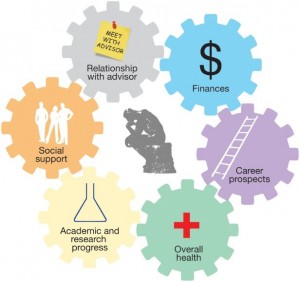
As the figure above shows, there are many factors that contribute to well-being. Do your own self-assessment to see where you have areas of strength and where you may need to seek more support. If you are experiencing significant stress, anxiety, or depression, there are offices that can help. You may be eligible for accommodations – even on a temporary basis – and it can be worth discussing with the Disability Services Office.

The UW Mindfulness Project aims to increase holistic wellness, self-inquiry, grounded leadership and compassion within UW community and beyond. Check out their Facebook Page.

Health & Wellness provides support, advocacy, consultation and education to the UW campus community. Check out their website for more information.

For additional resources and suggestions on many dimensions of self-care, visit the UC Berkeley “Be Well” page.


Originally posted on March 24, 2016.

Break?! Making Time For Yourself

We know that depending on your graduate or professional degree program, “spring break” looks very different from your days as an undergraduate–at least in terms of the work. You may be doing fieldwork locally or globally, applying for funding, preparing for job searches or qualifying exams, writing your thesis or dissertation, or working at a practicum site.

All this is true, but this doesn’t mean you can’t appreciate all that is you. In fact, given the tips we share below, you don’t have to wait for an official break to honor–and take care–of yourself. You can make that happen any time of the year.

Press pause. We move at break-neck speeds, going from one task to the next, barely allowing ourselves to just be. So go on, give yourself permission to slow down and breathe deeply, take several deep breaths–for however long it takes. The world will not end, we swear.

Appreciate yourself. Isn’t it funny how it can be easier to treat our friends and loved ones better than we treat ourselves, especially when they’ve been working hard or going through a rough time? So what’s stopping you from treating yourself to a nice meal or new pair of shoes? Why not buy a book you actually want to read? Why can’t you go on a staycation? You know what? There’s absolutely no reason why you can’t, so go on and do it! Do more than one. It’s not selfish. It’s self-love.

Laugh at yourself. You all work incredibly hard in your respective fields, and you are also awesomely, brilliantly human. Both are true. We all can’t help but be imperfect, so we might as well laugh at those embarrassing moments where we aren’t always our best selves.

Let go of guilt. Give yourself permission to not feel awful for taking care of yourself. By taking some time out for you, you’ll be able to return to longer term projects feeling energized. Also, taking time for yourself benefits everyone in your circle, because you’re all the more happier for it!

Warmly,

Jaye Sablan, Kelly Edwards, Ziyan Bai
Core Programs Team

Building and Maintaining Momentum

It’s nearing the end of winter quarter, and we know it can be difficult to keep your spirits and energy up as you work to fulfill on and off campus responsibilities.  We are right there with you.  Here are five tips to help keep you going:

Set achievable goals.  Rather than promising yourself that you’re going to spend 5 full hours in one sitting to work on a paper, approach time management realistically.  Try writing in 30 minute chunks.  Take a short break and pick it right back up.  This approach can be a great stress reliever, because you can make progress one step at a time.

Set boundaries.  Set healthy boundaries on campus, at work, and at home–and if you haven’t done so, now is a good time as any to practice. Take stock of what you have to get done in the next two weeks.  You can hold off on any tasks and responsibilities that can realistically wait for the next few weeks or month. Boundary setting helps you realize that you do have control over your schedule.

Meet with your support system.  Have you checked in with people who’ve got your back?  This may include faculty, graduate program advisors, loved ones, student peers, or work colleagues. More than one person in your support system is better. Check in with faculty via e-mail or in person and focus on one or two goals you have for the rest of the quarter.  Meet with a peer at the library or a coffee shop to write and go over ideas and drafts.  Connecting with loved ones and community is important and can remind you that you are more than just a graduate student.  Call, text, skype, share a meal, and/or make plans to spend time together.

Keep yourself nourished.  What keeps you going and energized?  Do you need a glass of water? How about a snack or meal?  A short nap or a good night’s sleep?  Is there a song, movie, hobby, or activity that restores your motivation?  Is there something you are looking forward to during Spring Break? Post an image or word in your work space or apartment that reminds of you of what you are looking forward to–to keep yourself moving toward that finish line. And it’s always helpful to reflect back on why you’re here in graduate school in the first place (insert personal, intellectual, and professional goals here).

Have faith in yourself.  You do have what it takes.  Really, you do!  You can do your best now and it will be enough.

Warmly,

Jaye Sablan, Kelly Edwards, Ziyan Bai
Core Programs Team

Keeping the Momentum Going Through the End of the Quarter

As we head into the last two weeks of the quarter, some of you are completing your first year of graduate school, wrapping up a capstone project, writing a draft of a dissertation chapter, or eagerly anticipating graduation—all the while juggling family and community responsibilities. Many of you are in the midst of a job search and interviewing for future employment. We at Core Programs understand that it’s crunch time, and we’re here to encourage you to keep your momentum going. Here are some tips to get you through that last leg of the quarter:

Plan and prioritize.  Make a daily list and prioritize what you must complete each day. De-prioritize anything that can wait. Because your time is scarce, create a “wish list” for things you can do after the crunch time has passed, and since they are on a separate list, you can trust you won’t forget about them!

Utilize your strengths.  We wrote about this a few newsletters ago. What time of the day are you most productive? Whether it’s the morning, afternoon, or evening, do your graduate work during the time you feel the most motivated. Incremental bursts of work will allow you to be more productive, rather than setting aside unrealistic chunks of time. You’ll also feel satisfied because you’re actually getting work done.

Get support.  Meet with a peer or two to review drafts of each other’s work or do mock job interviews in preparation for actual ones. Plan to debrief or release stress with a friend or colleague after you’ve worked through a milestone. Working with a colleague not only decreases isolation, it increases accountability.

Self-care.  It’s important to renew your energy level, especially during crunch time. Go for a 5-minute walk after writing for an hour, grade a set of student papers and then listen to relaxing music, or make plans to share a healthy meal with a friend before continuing work into the evening. Do whatever reduces stress, feels rejuvenating, and allows you to get in “me time.”

Acknowledge and reward milestones.  You’re nearly there, and that’s a feat in and of itself! Take time to recognize all your efforts each day and give yourself a treat for doing so! You definitely deserve it!

To all graduate and professional students who will complete your programs this year, we applaud you for your sheer dedication, tenacity, and passion. Best wishes in all your future endeavors! To all students who will be returning the coming year, Core Programs in the Graduate School will be here to encourage and support you! As always, we love hearing from you—your ideas, successes, frustrations, and thoughts on how we can better support your graduate experience. Contact us at cpinfo@uw.edu.